

These Are The 5 Worst No. 1 Hits Of The '90s
The chart-topping hit singles from the 1990s most fondly remembered today are the ones that moved the needle, expanding the idea of what makes good pop music, or simply that which got people singing along or out on the dance floor. This was the decade of Boyz II Men, TLC, 2Pac, Garth Brooks, and Nirvana, but the record labels still pushed their most inoffensive, middle-of-the-road, big-name acts, many of whom had been kicking around since at least the 1980s. They saturated the airwaves and MTV with their banal non-bangers, to where they couldn't help but go all the way to No. 1.
As far as we're concerned, those No. 1 hits of the 1990s are thus the worst No. 1 hits of the '90s; the ones that left no cultural footprint after their brief ascendancy to the top of the pops, and the ones we think are boring and not at all representative of the progressive music of the time. These are the five worst chart-toppers released between 1990 and 1999.
Extreme — More Than Words
Extreme's "More Than Words" contains multitudes, too many in fact, which is just one of the reasons why it's such an unsettling song. On an initial or casual listen, "More Than Words" seems like a sweet and spritely — and inconsequential — love song. All Extreme needs is an acoustic guitar and two harmonizing male voices to warble some lines ostensibly about how their love is too complex for mere human words to describe. But this is not the actual meaning of "More Than Words." This comes from the band Extreme, whose name is hilariously ill-fitting in the context of this soft No. 1 hit from 1991, but the rest of the time was a fast, loud, and annoying hair-metal band.
While that segment's poor musicianship and silliness don't show up here, the swagger and selfish sexuality do. "More Than Words" refers to how the narrator, as brought to life by singer Gary Cherone, thinks "I love you" is an empty phrase, as actions speak louder than words — and that the subject of the song should put up (or put out) and shut up. Yes, "More Than Words," heard at countless weddings in the 1990s, is an elaborate dismissal of sentiment and a bedroom coercion attempt masquerading as a tender folk song.
Bryan Adams, Rod Stewart, and Sting — All for Love
How many raspy, blonde, formerly edgy and cool rock stars does it take to sing a song consisting entirely of cliches and first-choice and/or best-choice rhymes, hastily written to promote a forgettable remake film? The answer is three: Bryan Adams, Rod Stewart, and Sting, on their 1994 No. 1 smash "All for Love." After the monumental success of his "(Everything I Do) I Do it For You," from the 1991 blockbuster "Robin Hood: Prince of Thieves," Adams got another call for another movie song when Hollywood made another medieval-type adventure a few years later, an update of "The Three Musketeers." Lightning didn't strike twice, even after he called in two other former innovative rockers turned low-effort soft-rock guys: Stewart and Sting.
The premise here is that they're like the three musketeers of soft rock singing about "The Three Musketeers," even incorporating the only thing anybody remembers about that story — the heroes' motto, "all for one and one for all." That's just one meaningless catchphrase among many in the song, which contains bland pronouncements of love ("I'll be the rock you can build on" and "When there's someone that should know/ Then just let your feelings show") that sound as if they came not from lived experience but overheard in other songs. It's woefully apt that when these singers belt out the title lyric, it sounds like "awful love."
Michael Bolton — When a Man Loves a Woman
There is a time and place for the anguished and emotionally pained to feel like it's physically painful to hear the belting and crooning of Michael Bolton. Taking on an iconic '60s love song that went gold, one of the most moving and deeply felt ballads of all time, isn't that. The original "When A Man Loves A Woman" was a classic No. 1 hit for Percy Sledge in 1966, and was full of heart and emotion. Bolton's chart-topper from 1991 is utterly soulless, as if designed to play softly in the background on adult contemporary radio in waiting rooms and over grocery store speakers.
At least Bolton doesn't try to culturally misappropriate and go the R&B route. Instead, he confidently dives into another genre of music pioneered by Black Americans: the blues. It's just the wrong approach for a song as complex and heartfelt as "When a Man Loves a Woman." All the simple, expected blues flourishes are bafflingly bouncy, while also being so half-hearted they sound less like a tribute to Bolton's supposed influencers and more like the kind of thing one would hear in a '90s-era beer commercial.
Barenaked Ladies — One Week
It's kind of fun that "One Week" spent exactly one week at No. 1 on the Billboard Hot 100 in 1998. While that's appropriate, it's one week too many for this goofy, sing-songy, meandering bit of tedious nerd-rock. "One Week" is a song at war with itself. Co-frontman Steven Page, a rock star who famously hooked up with a fan, sings some vaguely sexist verses and setups about a relationship in shambles with an inconsistent partner, before giving way to bandmate Ed Robertson's long and rambling verses of stream-of-consciousness babbling meets freestyle rap. Except it's not really rap because there's no rhythm to it, just Robertson trying to cram in as many words as he can before he runs out of time — on each and every line.
"One Week," and the musicians who play it, are palpably self-impressed. The smug smiles are audible as they unleash one inane rhyme after another, utter nonsense like "Chickity China, the Chinese chicken/ You have a drumstick and your brain stops tickin'." It's like Beck's wordplay masterclass "Loser" without the coolness or innovative genre-bending, or Billy Joel's historical recollection "We Didn't Start the Fire" without a point.
Will Smith featuring Dru Hill and Kool Moe Dee — Wild Wild West
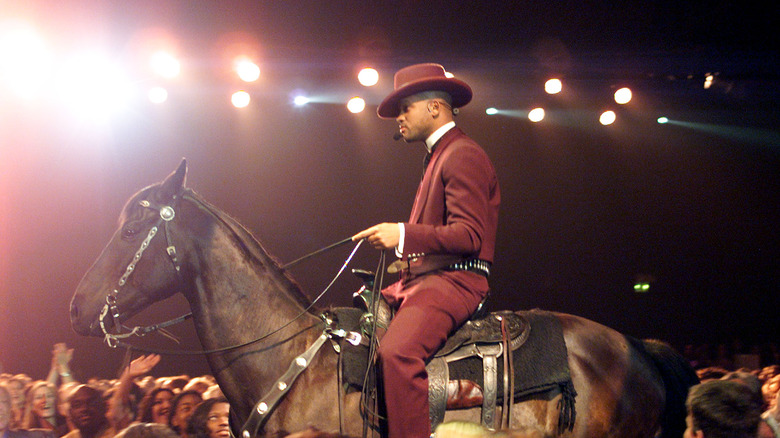
Will Smith was everywhere in the late 1990s. He'd star in some would-be summer blockbuster which he'd promote with a tie-in rap song, harkening back to his days in the hip-hop duo DJ Jazzy Jeff and the Fresh Prince. Those songs would blitz radio stations nationwide and all the major music video channels, generating buzz for Smith's film in a tacky way while also letting the star keep a foot in the rap world. The nadir of this trend was most certainly "Wild Wild West" and its theme song of the same name.
That critically reviled, overstuffed mess of a comic-action film, based on the '60s Western TV series, involves all sorts of wild steampunk gadgets and a devilish presidential assassin. All of that is detailed in Smith's ridiculous and unnecessarily cocky "Wild Wild West," a bombastic, overproduced affair that features liberal use of Stevie Wonder's "I Wish," R&B group Dru Hill absolutely screaming backup vocals, and Kool Moe Dee reprising the vocal riff from his '80s rap hit "Wild Wild West." There's nothing original in "Wild Wild West" the song, and it's even sloppier than the movie to which it's tied.
It's odd that anyone in 1999 would've wanted to listen to this song, as it can't live on its own when divorced from an unpopular film. This song must have made it to No. 1 simply because the record label pushed so much radio airplay.