

5 Classic Rock Songs From The '70s That Are Worth A Head-Turning Amount Of Money
Rock music got harder and more inventive in the 1970s, and as the elements of what makes a great rock song solidified, the classic singles of the era emerged, and a lot of them are eternal money factories. Massive hits at the time, those tunes are forever associated with the singers and bands that created them and took them to the top of the charts. Over the years, the love and appreciation never subsided — those tracks can still be heard every day on classic rock radio stations, and they still garner appearances on movie soundtracks and rack up big numbers on streaming music services.
Every single time one of these stalwarts of '70s classic rock is played in public or in private, it puts a bit of cash into the pockets and coffers of artists and record labels. Whether it was from massive sales of the 45 or the full-length album from which they came, back then or now, when it comes up on the radio or a streamer, that just means more money. Here are the five classic rock songs from the '70s that have made the most money, and continue to do so, proving themselves to be lucrative, hard-rocking cash cows.
Bohemian Rhapsody — Queen
Ambitious, weird, and so long that it's broken down into five distinct sections, the mini-opera that is Queen's "Bohemian Rhapsody" probably shouldn't have worked, but it did. It rocks, it's emotionally impactful, and it became a universally beloved cultural touchstone. Trailing behind only a couple of charity singles, "Bohemian Rhapsody" is the third-best-selling single ever in the U.K. It's gone to No. 1 in Queen's country of origin twice — after its release in 1975 and then in 1991 following the death of singer Freddie Mercury.
Over in the U.S., "Bohemian Rhapsody" made it to the Top 10 and sold more than 500,000 copies in the '70s, then came back stronger in 1992, reaching No. 2 after it was celebrated in the blockbuster comedy film "Wayne's World." In the U.S. alone, the "Bohemian Rhapsody" single has notched sales equivalent to that of 10 million copies, the most of any song that debuted in the 1970s.
While also collecting 3 billion listens on Spotify, it has inspired the acquisition of so much other Queen media. "Bohemian Rhapsody" appeared on "A Night at the Opera," a 3-million-seller, as well as on two major collections. Queen's "Greatest Hits" from 1981 has sold 9 million copies, and "Classic Queen" from 1992 shifted 3 million units. Clearly, "Bohemian Rhapsody" and its seemingly endless popularity and marketing potential explain why, when Sony acquired Queen's catalog in 2024, it had to fork out $1.27 billion.
Piano Man — Billy Joel
A nearly six-minute-long story song about sad middle-aged people drinking away the pain of broken dreams that's dominated by piano and harmonica doesn't seem like the most likely candidate for legendary rock song status, but that's the magic of Billy Joel. "Piano Man," a seemingly autobiographical, first-person account of playing music in the same sleepy bar, was Joel's first hit single — it peaked at No. 25 in 1974 — launching a storied career and becoming the singer-songwriter's signature composition and nickname.
The financial success of "Piano Man" came slowly, but it did come. Despite its moderate initial chart success, "Piano Man" in the form of a single has sold 8 million copies across all formats. Owning the title song also certainly motivated a large percentage of the 5 million Joel fans who bought the full-length LP "Piano Man."
When Joel released his double best-of, "Greatest Hits: Volume I & Volume II," "Piano Man" was a must-include track, and it helped push that collection to sales of 23 million. It remains Joel's most popular '70s recording on Spotify, garnering 1.2 billion streams, and "Piano Man" is just one of the treasures in the piano man's catalog, which was nearly sold in 2022 for an asking price of around $400 million.
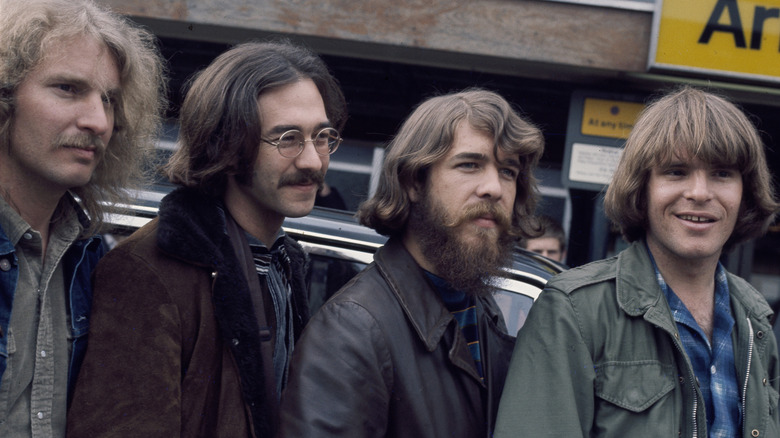
Have You Ever Seen the Rain? — Creedence Clearwater Revival
It's an undeniable truth of Creedence Clearwater Revival that the swamp-rock band from California was among the most popular acts of any kind in the late 1960s and early 1970s. The group, led by powerhouse singer-songwriter John Fogerty, set a weird Billboard record, scoring five No. 2 hits without ever going to No. 1.
All of those hits are jaunty jams, like 1970's "Travelin' Band" and "Lookin' Out My Back Door," while CCR's top-selling single of the '70s is the beautiful and bittersweet ballad "Have You Ever Seen the Rain?" First popping up on the LP "Pendulum," which has sold a million copies, "Have You Ever Seen the Rain?" only got as high as No. 8 on the pop chart in the spring of 1971, but it went on to sell 8 million copies.
Record stores and streaming platforms did great business with CCR content for decades after the band's 1972 breakup. The best-of album, "Chronicle: The 20 Greatest Hits," put "Have You Ever Seen the Rain?" into the hands of 12 million fans, while that song is CCR's top song on Spotify by a significant margin, listened to 2.2 billion times.
The Joker — The Steve Miller Band
Only in the early 1970s could a groovy, bluesy, freewheeling guitar jam with lyrics alternately boastful and baffling hit No. 1 on the pop charts. But in 1974, the Steve Miller Band did just that, topping the Hot 100 for a week with "The Joker." In addition to blazing guitar solos and lots of guitar noodling, frontman Steve Miller brags about how his reputation precedes him, as he is the space cowboy, the gangster of love, and a guy named Maurice who speaks of "the pompatus of love."
"The Joker" is integral to the story of the Steve Miller Band, and fans never really stopped dancing and singing along. "The Joker" has sold the equivalent of 7 million copies, accounting for physical sales, downloads, and streaming. The album that spawned the song, also called "The Joker," moved a million units, and it's also a big reason why 15 million people purchased the Steve Miller Band's "Greatest Hits 1974–78," making it one of the top-selling best-of collections ever.
As of 2026, "The Joker" has been listened to 624 million times on Spotify, which earns a bit more money for Miller and company, as does the fact that it was sampled in Shaggy's 2001 No. 1 smash-hit "Angel."
(Don't Fear) The Reaper — Blue Öyster Cult
It's just a part of the truth of Blue Öyster Cult that it doesn't have a huge catalog of well-known songs or the overarching cultural visibility of the bigger bands of the '70s. Its legacy is pretty much wrapped up in one song, but it's one that's made the people associated with it very wealthy. "(Don't Fear) The Reaper" hit No. 12 in 1976, the only Top 20 hit Blue Öyster Cult ever recorded.
The ominous, hypnotic song about death and what awaits us on the other side possesses what few other rock songs do: cowbell high in the mix. Those who hadn't yet noticed the overwhelming use of the percussive instrument in "(Don't Fear) The Reaper" certainly have after the famous 2000 "Saturday Night Live" sketch that fictionalized the recording session for the song, which included many jokes and comments about that cowbell.
Forever part of classic rock radio station playlists and boosted by the popularity of the "SNL" sketch, "(Don't Fear) the Reaper" has sold about 6 million copies to date across all formats. The LP on which the song first appeared, "Agent of Fortune," was purchased by a million people who needed to hear the song as often as possible. The more than 707 million spins and counting on Spotify continue to funnel money to Blue Öyster Cult.