

5 Musicians Who Famously Used Cold-Blooded Lyrics As The Knife To Trash Their Exes
In pop, country, and rock music, relationships often serve as fuel for creative fire. Sure, there are countless songs depicting longing and romance, but there also are many representing the other side of the coin: the fiery end of love and bitter ashes that follow. More than just breakup songs about heartache, they depict anger at or simmering resentment of ex-lovers or spouses. Clearly, there's a risk to dating or loving a famous songwriter; if something goes wrong, you might end up in their music, and let's just say, you may not like what you find.
Inspired by the fallout of breakups or divorces, musicians as various as Bob Dylan, Prince, and Alanis Morissette have wielded song to set things straight. Fueled by real resentment, frustration, and heartbreak, these and other artists have used lyrics to trash their exes. Love can be a cold, bitter business. Unfortunately for their ex-partners or spouses, the songs that have emerged from the crucible of those crumbling relationships have become hits and timeless classics. That probably stings a little.
Songwriters can be cagey about their inspiration; they often don't directly say what their songs are about. In the absence of definitive proof (in some cases), we sought artists who it can reasonably be assumed were addressing specific exes. We wanted lyrics that cut deep but were cold as ice: lines almost clinical in their takedowns. Lastly, we included a range of musical styles to reflect the many ways popular music depicts fading relationships. In taking aim at those who hurt them, each of these musicians succeeded in making truly legendary, unforgettable songs.
Bob Dylan Doesn't Look Back
If there's one songwriter who knows how to add barbs to his lyrics, it's troubadour of a generation and Nobel Literary Prize winner Bob Dylan. With his keen eye and clever turns of phrase, he's written iconic breakup ballads: "It's All Over Now, Baby Blue," "It Ain't Me, Babe," and "Tangled Up In Blue," to name a few. But with "Don't Think Twice, It's Alright," he directed the full ferocity of his lyrical arsenal at an ex to absolutely devastating effect.
In the early '60s, Bob Dylan dated the artist and civil rights activist, Suze Rotolo. She's the woman walking towards us down a Greenwich Village street with Dylan on 1963's "The Freewheelin' Bob Dylan" album cover. Together from 1961 to 1964, theirs was a rocky, on-and-off relationship. "Don't Think Twice, It's Alright" was written when Rotolo was taking a break from Bob and studying in Italy in 1962. While he's never confirmed it, rock critics and historians think it addresses her.
If "Don't Think Twice, It's Alright" does, then poor Rotolo catches some scorching burns. The song's narrator is equal parts resentful and dismissive of his ex-lover. Lines like "You're the reason I'm trav'lin' on" and "We never did too much talkin' anyway" drop like bombs of bitterness. Things get even more explosive in the last verse, as Dylan sings, "But goodbye's too good a word, gal / So I'll just say fare thee well," which leads to the ultimate kiss-off: "You just kinda wasted my precious time / But don't think twice, it's alright."
Alanis Morissette And The Mess He Left
Few albums depict collapsing relationships and the emotional fallout that follows better than "Jagged Little Pill." One of the albums that defined the '90s sound (and one of the decade's top-selling), alternative rock singer-songwriter Alanis Morissette's third studio album seems to stew in raw emotions and subject matter. This is certainly the case with the breakout single, "You Oughta Know," a searing indictment of an ex and a fiery revenge anthem.
The song's speaker is an avenging angel, storming back into the life of an ex that's moved on. "Did you forget about me, Mr. Duplicity?" she sings, which leads to the searing slant rhyme: "It was a slap in the face how quickly I was replaced." Putting a finer point on it, the final verse just about breaks skin: "And every time I scratch my nails / Down someone else's back, I hope you feel it / Now can you feel it?" The lyrics drip with scorn and indignation.
Morissette never revealed who the song is about, and there are several possibilities. The most popular theory is that it's actor Dave Coulier (of the sitcom "Full House"), whom she dated just before "Jagged Little Pill's" release. After hearing it for the first time, he told People, "I thought, 'Ooh, I think I may have really hurt this woman.'" Asked about it on a 2019 episode of the "Watch What Happens Live With Andy Cohen Show" (via YouTube), Morissette refused to answer, but added, "I am intrigued at the thought ... that more than one person has taken credit."
Travis Tritt Won't Answer Her Calls
Country music is chock full of bitter ballads of broken hearts. However, few are as downright incendiary as Travis Tritt's "Here's A Quarter (Call Someone Who Cares)." This single off his multi-platinum 1991 album, "It's All About To Change," takes aim at an ex that's cheated, regrets the breakup, and wants to come back.
The title serves as a bitter refrain. "Call someone who'll listen and might give a damn," the second verse leads off, "Maybe one of your sordid affairs / But don't you come 'round here handin' me none of your lines." Making it extra cutting is the image of sending an ex to the pay phone: a relationship and the resulting pain reduced to a tossed-off coin.
Tritt never shied away from revealing his inspiration. He wrote "Here's A Quarter" before he broke into country music, as his second marriage was collapsing. While examining the divorce papers, he got a call from his ex, begging him to get back together. In his book (co-written with Michael Bane), "10 Feet Tall and Bulletproof, he recalls, "Far too much water had gone under the bridge for that ... It's done" (via American Songwriter). Anyone listening to the song can hear that the hurt and rage is truly authentic.
Prince Puts Love On Trial
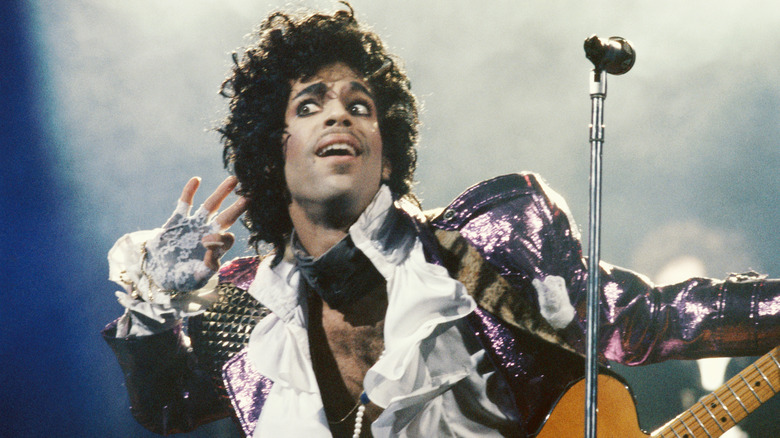
No one sang about affairs of the heart quite like Prince. Along with legendary love anthems and ballads like "I Wanna Be Your Lover" and "Adore," some of his songs channel heartbreak and even hate. What makes the breakup song "Eye Hate U" so devastating is that while funky and groovy, it oscillates between outright contempt and longing for an ex. The ending refrain goes straight for the jugular and heart of the issue: "I hate you / Because I love you / But I can't love you / Because I hate you."
Don't cheat on the narrator of "Eye Hate U." Resentful that "you gave your body to another in the name of fun," the chorus lays everything bare: "It's so sad but I hate you like a day without sunshine." In the spoken word interlude, there's a trial, and we can all guess the verdict. Released in 1995 during the "Artist Formerly Known As Prince" period, the song captures the complex feelings that rise from the ashes of love. But whose?
In the early '90s, Prince signed then fledgling singer and dancer Carmen Electra to his Paisley Park Records label, and briefly dated her. Things took a turn; despite having other lovers, he grew jealous when she went on a date with someone else. In a move only Prince could pull off, he broke things off by playing her the song. "I literally cried in front of him," Electra recalled to Far Out, "I think he just wanted me to hear it and know that he was really upset."
Courtney Love Isn't Just Writing About Billy
Perhaps the most lacerating — and certainly the loudest and heaviest — song mentioned on this list is Hole's "Violet," off "Live Through This," one of many iconic alternative rock releases of 1994. Courtney Love's lyrics are a brutal, searing indictment of a self-absorbed ex: a love-taker rather than giver. As with "Eye Hate U," the speaker seems trapped, spinning between pangs of rage, desire, and self-loathing.
"Violet" depicts the radioactive aftermath of a toxic relationship. "When they get what they want / And they never want again" goes the pre-chorus, making us wonder what "it" might be: abuse? Love? Self-worth? Sex? Attention? In the chorus, the lyrics are equal parts take-down and demand: "Go on, take everything / take everything, I want you to." What's disturbing and brilliant about this song is that, as much as the speaker loathes this ex, she very well may hate herself even more.
In 1990, before she was with Kurt Cobain, Love dated The Smashing Pumpkins' frontman Billy Corgan, leading to rumors that he was the ex in "Violet." During a 1995 performance on the "Later... With Jools Holland" show, Love added fuel to that fire; it's a "song about a jerk," she said, "I hexed him and now he's losing his hair" (via Rolling Stone). Speaking to NME in 2024, she clarified, "It's not just about Billy Corgan. It's about sitting on the fire escape of his flat, sipping cheap wine and taking Vicodin (oh, to be young!)." Steeped in bitterness, "Violet" doesn't just spill the tea; it knocks over the whole tray.