

If You Know These 5 Under-The-Radar Songs, You're A True Fan Of '80s Classic Rock

The 1980s tend to divide classic rock fans. With many of the biggest classic rock bands of the '60s and '70s already winding down or past their prime by the start of the decade, music from this period is often dismissed as overproduced, overly theatrical, and generally overblown. That's before you even get to the increased prevalence of synth-heavy production and electronic textures in the work of many established acts that purist classic rock listeners simply don't go for. But open-minded fans will know that, even looking beyond the big rock hits of the era, there is a wealth of great classic rock from the 1980s to uncover.
Here, then, are five of our under-the-radar picks from the decade in question that didn't get a great deal of attention the first time around, and which are still underplayed today. For our purposes, "under-the-radar" means they failed to hit the Top 40 of the Billboard Hot 100 or were relegated to album deep cuts and never gained the radio play they deserved. If you already know them despite their limited exposure, your classic rock credentials are assured.
Tom Petty and The Heartbreakers – Straight into Darkness
"Straight into Darkness" wasn't a hit for Tom Petty and The Heartbreakers when released as a single in 1982, failing to land on the Billboard Hot 100 at all. But down the years it has become a firm fan favorite, a powerful slowburner of a track revealing Petty at his moodiest and most introspective.
The track opens with an atmospheric piano part, which sets the tone for an unsettlingly bleak couple of verses that tell the tale of a relationship suddenly reaching its terminus. Perhaps this aspect of the song is what held it back — by contrast, the tracks that propelled Petty to superstardom such as "Don't Do Me Like That" and "Refugee" seem swaggering and defiant.
But play "Straight into Darkness" to the end, and you'll see that Petty then reaches for a more optimistic worldview, telling us that "Real love is a man's salvation / The weak ones fall, the strong carry on." The track places Petty in the lineage of songwriters like Bob Dylan in his ability to make grand, poetic statements about life and love. It is found on the underrated 1982 album "Long After Dark," the expanded edition of which includes a live version of the track recorded for French TV, which gives the song some added punch (and cowbell, which is always a good thing in our book).
Fleetwood Mac – Straight Back
Few bands in the history of rock music have achieved the commercial heights of "Rumours"-era Fleetwood Mac, and the continuing chart success of the band's late-1970s output means that many great songs from its 1980s albums remain overlooked by more casual listeners. "Straight Back" appears as an album track on Side-B of the 1982 album "Mirage," and is generally overshadowed by bigger songs from the album, most notably the singles "Hold Me" and "Gypsy."
The track was written by Stevie Nicks, who at the time was torn between her burgeoning solo career and her commitment to Fleetwood Mac. Relations between the band members had been strained since the "Rumours" sessions, and Nicks had moved on from her famously torturous relationship with bandmate Lindsey Buckingham and flings with founding member Mick Fleetwood and The Eagles' Don Henley to find new love with producer Jimmy Iovine. Iovine had supported Nicks in going solo, and the two moved in together just days after they began work on her debut album "Bella Donna." But their relationship came to an end in 1981, when she returned to Fleetwood Mac.
Many of Nicks' greatest songs revolve around the end of relationships, dreams, and possible futures, and while Nicks' relationship with Iovine is certainly the emotional core of "Straight Back," the song exquisitely blends her feelings about both her lover and her band. Quietly affecting, it deserves its place among steelier Nicks classics such as "Landslide" and "Silver Springs" for giving an extraordinary insight into Nicks' fraught emotional landscape as she negotiated both her love life and her dream of being one of the biggest rock vocalists on the planet.
The Kinks – Do It Again
British Invasion legends The Kinks may be best known for the garage rock pioneering singles the band released in the 1960s as well as the turn that songwriter Ray Davies took toward traditional forms of composition in the 1970s. But even in the 1980s the "You Really Got Me" stalwarts were continuing to put out great rock singles, which, like "Do It Again," still sound fresh despite narrowly missing out on the Top 40 of the Billboard Hot 100.
Davies is renowned for his willingness to stray from the topics of love and longing that make up so much of the popular music canon, and in "Do It Again" he once more proves his songwriting skill, delivering a pithy track about the drudgery of repetitive work. Despite the theme, the track is hugely entertaining, employing the decade's hefty production values to prove that the latter-day members of The Kinks could rock as hard in the '80s as they could back in the '60s. It peaked at No. 41, outperforming many other Kinks singles of the era, but it still feels like an unfairly low return for one of the most entertaining classic rock songs of the mid-1980s.
Journey – Chain Reaction
Journey was one of the most successful stadium rock acts on the planet in its heyday, thanks to a flurry of hit singles including six Top 10 hits during the 1980s alone. But even as Journey enjoyed hit after hit, there remain some songs that didn't get the love they deserved. "Chain Reaction," the B-side to "Send Her My Love" and a track on the 1983 album "Frontier," is up there with Journey's best, but is overlooked by all but the band's most hardcore fans.
From the very opening "Chain Reaction" goes hard, with rolling drums and a chugging lead guitar part that together create a rumbling foundation for Steve Perry's impressive vocal, which is at full throttle here. The song lacks the infectious chorus of Journey's most commercial tracks such as "Don't Stop Believin'," but its relentless stomp and impressive solos made it a crowd-pleasing live track. Meanwhile, it is a key song in the band's discography that demonstrates Perry and company are more than just power balladeers, and an under-the-radar fan favorite to those in the know.
The Who – Eminence Front
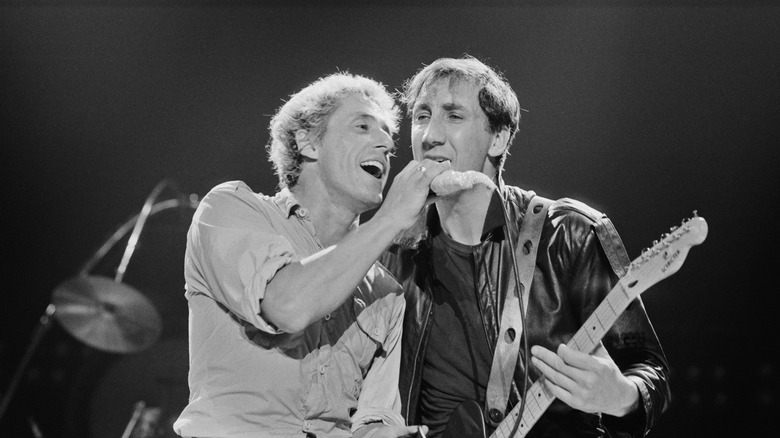
Roger Daltrey may once have told the world "I hope I die before I get old," but by the 1980s the early-middle-aged members of The Who were still trying to keep up with the latest sounds. To see one of the band's most interesting — but often overlooked — efforts from the decade, look no further than 1982's "Eminence Front." Written and sung by primary songwriter Pete Townshend, the song seems prescient of much of the decade's later excesses, offering a critique of the wealthy's extravagant drug use (Townshend himself was just newly sober when "Eminence Front" was composed).
"Eminence Front" begins with a mild electronic drum pattern and frenetic synth line, before the arrival of a hard-hit analog kit, chunky bass, and forward-thinking guitar part. Though it only peaked at No. 68 as a single in the U.S., its parent album, "It's Hard," entered the Top 10. Utterly of its time, "Eminence Front" sounds peak-'80s to modern ears, and is all the better for it.