

5 Epic Guitar Solos That Defined The '80s
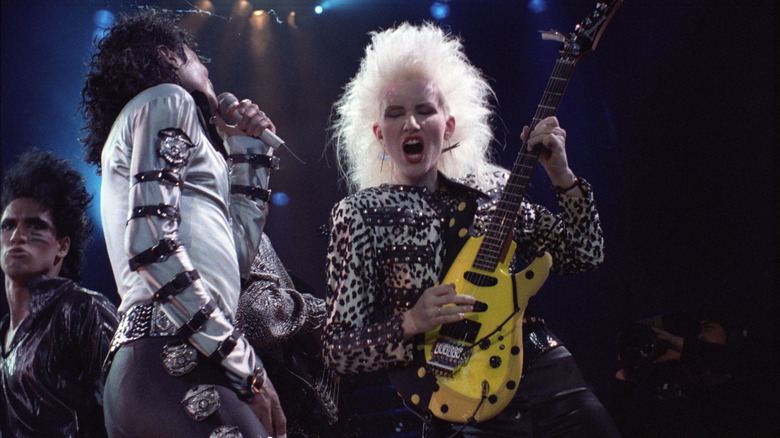
Maximum flash, maximum showmanship, maximum spandex, and maximum hair: This was the '80s — or at least, much of it. Guitars pushed to the absolute forefront of the stage, where folks like Eddie Van Halen, Randy Rhoads, Steve Vai, Stevie Ray Vaughan, and many more, taught their instruments some serious manners. Out of all such talent, some guitar solos define the '80s better than others.
But what does it mean to "define the '80s"? A solo can't just be cool and rippin', technically accomplished, inventive, or even the best of the best. Rather, it has to embody the musical traits of the times or have served as a cultural touchstone for the general public. This means omitting lesser-known solos like those on "Chapel of Ghouls" by death metal icons Morbid Angel, because most folks won't know what we're talking about. We also have to omit plenty of honorable mentions, like the brief, soaring solo from "Don't Stop Believin'" and the shimmering, laid-back solo from "Everybody Wants to Rule the World," plus loads of worthy solos from a gajillion hair bands, because other solos meet our criteria better.
Most music lovers can probably guess one or two entries on our list, like Jennifer Batten's solo on Michael Jackson's "Beat It." Others you'll remember when you hear them, though all of them are iconic.
Beat It — Michael Jackson (Eddie Van Halen/Jennifer Batten)
Yeah, Jennifer Batten could shred, with or without that crazy mask she wore in the late '80s through '90s. As Michael Jackson's very recognizable, sometimes show-stealing, and criminally underrated guitarist, Batten proved her stuff night after night. But out of all of her work, it's the solo from "Beat It" off 1982's "Thriller" that remains the most memorable, uniquely phrased, and truly '80s-centered solo in her repertoire. It was even beautifully parodied by Weird Al Yankovic in "Eat It," when the guitarist in Al's music video explodes as his guitar overheats from shredding.
But, well ... Here's where we demystify things a bit. Even though Batten toured with Jackson on multiple world tours and earned her bona fides, she didn't write the solo for "Beat It" or play on the studio recording — Eddie Van Halen did. You know, the guy who overhauled guitar playing overnight by popularizing two-hand tapping on "Eruption" off Van Halen's 1978 debut — a track that defined rock history that year and beyond. This explains why Batten's "Beat It" solo sounds like a Van Halen solo, right down to the tapping and chromatic movements (slight pitch shifts up and down the fretboard). It also explains why Batten called the solo very difficult to play in an interview with Vinyl Writer Music.
This is all fine by us, though, as it essentially means that Van Halen — one of the biggest rock bands of the '80s — fused with Michael Jackson via "Beat It" and Batten's fingers at live shows. The "Beat It" solo bundles up Michael Jackson, Van Halen, MTV music videos, Weird Al, and blistering guitar antics all in one. You can't get much more '80s than that.
Crazy Train — Ozzy Osbourne (Randy Rhoads)
Hey now, you gotta listen to our words, yeah yeah. That's pretty much what Ozzy Osbourne, the grand Prince of Darkness who passed into the underworld in 2025, says before guitarist Randy Rhoads annihilates the solo in "Crazy Train." Rhoads indeed goes off the rails on a crazy train with a solo that's basically 90% tappy-taps (one-handed and two-handed) and bends with nary a long note to be found. Rhoads' solo is incredibly recognizable, very evocative of its time, and comes equipped with one of rock and metal's most legendary, if not the most legendary, frontmen: the Blizzard of Ozz.
Indeed, that was the name of Ozzy's solo project when Rhoads joined it in 1979. Rhoads, who also co-founded Quiet Riot, played guitar on Ozzy's first two full-length albums, "Blizzard of Ozz" and "Diary of a Madman"; the former contains "Crazy Train." Likely he would have continued as Ozzy's guitarist if he hadn't died extremely young in a plane crash at 25 in 1982. But Rhoads left his mark nonetheless and set the standard for future Ozzy guitarists like Zakk Wylde, who went on to form Black Label Society.
But you don't need to know all this backstory to hear how superb Rhoads' solo is, how demanding of emulation, how well it expands on the core musical ideas of "Crazy Train," and how it segued into the decade to follow when "Crazy Train" released in 1980. "Crazy Train" bridges the history of Black Sabbath-led heavy music with the flashy stylings of '80s rock, with Rhoads' solo on its throne.
Sweet Child O' Mine — Guns N' Roses (Slash)
Guns N' Roses hit the public at the climax of '80s musical indulgence in 1987 with a debut that outdid every one of their albums to follow, "Appetite for Destruction." Axl Rose, Slash, and the boys (a lot of musicians went through the band's revolving door) assaulted the general public with truly wild, out-of-control energy that drove their album to become the highest-selling debut in history. But their image, which was firmly rooted in their era, couldn't have worked without quality music that typified its time. And for that, we turn to Slash's solo on "Sweet Child O' Mine."
Slash's solo isn't over-the-top or technically overwhelming. Rather, it goes the opposite direction toward highly melodic and vocal. It rephrases the main melodic line of "Sweet Child O' Mine" in a minor key that riffs on Rose's vocal lines, which leads into the song's "Where do we go?" bridge section. Even though GNR could easily be accused of being a brand more than a band, this is the kind of taste-over-flash musicianship that represents the best of its time and the best of GNR, and shows what '80s musical trends were capable of at their compositional peak.
There's an often-cited but false tale about "Sweet Child O' Mine" accidentally coming from a warm-up exercise of Slash's. Slash said on "The Eddie Trunk Podcast" (per Guitar World) that he very intentionally built the song's main riff like any other, noodling around on his guitar till something sounded good. The same methodology applies to the song's quintessentially '80s solo.
One — Metallica (Kirk Hammett)
Though metal started dividing into its innumerable subgenres in the '80s, thrash reigned supreme. And out of the Big Four, as they've come to be known — Slayer, Metallica, Megadeth, and Anthrax — the Big One emerged: Metallica. Doing as much for headbanging as they did for merging the powerful with the emotional, Metallica was always the biggest metal band around. But even before they put out the biggest album of their careers and best-selling album of the past 35 years by a U.S. band, 1991's self-titled "Metallica" (aka "The Black Album"), guitarist Kirk Hammett produced some of the best lead lines of his career. Out of all of them, "One" from 1988's "... And Justice for All" rises above the rest.
The absolutely memorable, highly recognizable final solo (note this theme throughout our choices) comes at the emotional heights of a song about a veteran and quadruple amputee. We get James Hetfield's "Darkness, imprisoning me / All that I see, absolute horror" line atop gatling-gun kick drums and a chugging, down-picked riff, which segues into Hammett's frantic solo. Characteristic of the decade, it features plenty of double-hand tapping, chromatic ascents and descents, and arpeggiated shenanigans. This one solo by that most well-known of metal bands, then and now, represents the entire, greater state of heavy music in the '80s.
According to an interview with Guitar World, we once again have Eddie Van Halen's finger-stylings to thank for inspiring Hammett. Hammett said the solo was easy to write, as he just let himself be carried away by the rest of the band's rhythmic pulse.
Purple Rain — Prince & the Revolution (Prince)
It's hard to know where to start with Prince, who ruled the '80s as a singular, standalone visionary, producer, composer, performer, and lest we forget: guitarist. Even if we believe tales that say he could play 27 instruments, his guitar skills outstripped the rest. We're not just talking speed, but musicality and composition, which arguably reached their peak along with Prince's career on his solo for 1984's "Purple Rain," the song from the album of the same name.
Prince's solo on "Purple Rain" is such an accomplishment not just because it's nearly two minutes long, but because every part feels essential. Running from about three minutes, 45 seconds to five minutes, 20 seconds (but arguably longer into the outro), it takes the emotional baton from the rest of the song and runs it to the top of Mt. Olympus. Its distinct sections echo and rephrase "Purple Rain," especially its very simple, but equally effective, three-note motif around four minutes, 40 seconds (which continues after Prince's vocals come back). The solo remains hummable and vocal (in the human vocal range), which demonstrates how Prince always amplified feeling over physically virtuosic playing no matter how he could shred. This solo also runs counter to many '80s solos as a result, but still exemplifies the lavishness of the times.
Fans and newcomers alike got the chance to be transported back to those times in 2007 when Prince's guitar wailed at the Super Bowl in the rain (when he did not get electrocuted, we should add). This rendition showed the "Purple Rain" solo at its finest, complete with an absolutely disgusting guitar tone; and so the best solos of the '80s rang on.