

The 5 Most Beloved Covers Of '60s Hits
Sometimes the most beloved songs are covers, including songs you never knew were covers. Sometimes these covers sound better than their originals, like in the case of certain covers of songs from the '70s. But, it's the '60s that produced the source material for some of the most beloved, well-known, and instantly recognizable covers that have unquestioningly become the definitive versions of songs.
Interestingly, most of our choices for such covers not only come from '60s, but were also covered in the '60s. The Beatles' "Twist and Shout" from 1963, for instance, was the sixth officially released cover of the song in three years, but how many people associate "Twist and Shout" with the original artists, the Top Notes? People remember whatever version of a song captivated them the most, and that's that. Reasons may vary, whether it be something as vague as vibe or something more musically complex, like a measured modification to a melodic line. But in all cases, one cover version always wins out. We mentioned "Twist and Shout," which is an obvious choice. This cover and our other choices brought out the best in their originals and helped secure the careers of those who covered them.
Respect — Aretha Franklin
We're betting that plenty of people never knew that Aretha Franklin's "Respect" from 1967 is a cover, possibly even the reader at this very moment. Indeed, this most beloved of finger-wagging, electrifying empowerment songs comes from Otis Redding two years prior in 1965, whose original reached No. 35 on the Billboard Hot 100. But it's Franklin, her attitude, and her voice that embodied "Respect" so thoroughly that it's practically impossible to believe that the song came from anyone else.
"Respect" had a simple journey from Redding to Franklin. As Franklin wrote in her 1999 autobiography, "Aretha: From These Roots," "It was the need of a nation, the need of the average man and woman in the street ... everyone wanted respect." Franklin was speaking within the context of the Civil Rights Movement and second-wave feminism (roughly 1963 to 1980), which largely focused on women in the workplace, gender roles in families, and reproductive rights. "Respect" doesn't go into deep dialectics to get its point across but delivers its sentiments through Franklin's attitude and vignettes like, "Oh, your kisses, sweeter than honey / And guess what? So is my money." These lyrics differ a bit from Redding's, which, if we're being honest, come across as a bit too transactional. Franklin also added the famous, "Sock it to me, sock it to me" line and R-E-S-P-E-C-T spelling bit.
"Respect" garnered Franklin her first two Grammys out of 18 in 1968 and became her signature song. She remained appreciative of its impact on others her entire life, in the process living up to a quote of hers about appreciating what people give you. Respect, indeed.
I Heard It Through the Grapevine — Marvin Gaye
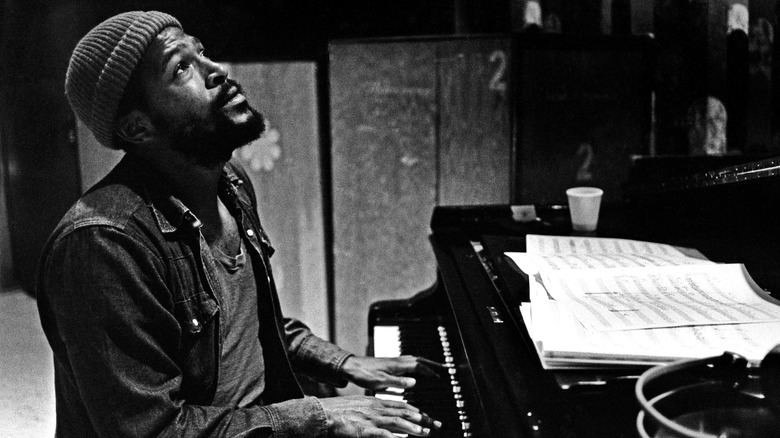
Soul singer Marvin Gaye is one of those untouchable artists who deserves all the praise that's been heaped on him. A song like "Mercy Mercy Me (The Ecology)" from 1971's "What's Going On" might grant boomers bragging rights over other generations, but it's his cover of "I Heard It Through the Grapevine" that crushed the charts three years earlier in 1968 when it hit No. 1 on the Billboard Hot 100 and stayed there for seven weeks. Gladys Knight and the Pips' version reached No. 2 the year prior in 1967, but Gaye's version outstrips it and roughly 320 other covers by far.
True to its title, "I Heard It Through the Grapevine" passed from singer to singer like a confusing game of telephone before Gaye covered it. His beloved 1968 version was the third version in three years, with the original performed by Smokey Robinson & the Miracles in 1966 (written by Motown songwriters Barrett Strong and Norman Whitfield). But, this version wasn't released until 1968, meaning that Gladys Knight & the Pips' 1967 cover was the first version the public heard. Then, of course, there's Creedence Clearwater Revival's well-known 1970 version from "Cosmo's Factory," when John Fogerty "hoid it through the grapevine," but that only went to No. 43.
All renditions have value, including Gladys' perfectly fine take with its crisp, plucked bass line. But, it doesn't have the mojo, charisma, and compositional nuance of Gaye's version. Plus, Gaye's version tweaks the song's chorus into the one we all know — far more melodically satisfying and memorable than Gladys' comparably stagnant version. At this point, the song belongs to Gaye through and through.
Twist and Shout — The Beatles
It's kind of odd to think that a song from the Beatles can take boomers back to their wildest nights, but that's how it is. We're talking about "Twist and Shout" from the Beatles' 1963 debut, "Please Please Me," aka the song that showcases John Lennon's yowling vocal chops better than any other Beatles song (no matter that he didn't like it because it shredded his voice). The song reached No. 2 on the Billboard Hot 100 in 1964, a year when the Beatles basically owned the musical world; they had six No. 1 songs that year out of an impossible 31 — yes, 31 — Hot 100 singles. No doubt this absolute domination went far in cementing the Beatles' version of "Twist and Shout" as the definitive one, aside from the song's musical merits.
"Twist and Shout" had a twisty route to the Fab Four — more so than "I Heard It Through the Grapevine" reaching Marvin Gaye. "Twist and Shout" isn't just a cover of a cover, it's a cover of a cover of a cover of a cover. We go from the relatively unknown original by the Top Notes in 1961 to an Isley Brothers cover that peaked at No. 17 on the Billboard Hot 100 in August 1962. Chubby Checker — never one to miss out on a twist-based song — released his version later that year, but it didn't chart at all. Then, the floppy-haired kids from Liverpool stepped in to infuse some special magic into the proceedings. It's in their hands that "Twist and Shout" feels like the embodiment of rock 'n' roll.
With a Little Help From My Friends — Joe Cocker
Now it's time for someone to cover the Beatles and outdo them — even Paul McCartney thought so. We're of course talking about Joe Cocker's beloved rendition of the Beatles' "With a Little Help From My Friends" from 1967's "Sgt. Pepper's Lonely Hearts Club Band," a song that was a modest hit by Beatles' standards. (A 1978 rerelease hit No. 71 on the Billboard Hot 100.) Cocker released his cover in 1968, and it skyrocketed to the No. 1 position on the U.K. Official Singles Chart.
Simply speaking, Cocker's cover blows the Beatles' original out of the water. The Beatles' never had any high ambitions for "With a Little Help From My Friends." It was more of a joke about Ringo Starr's vocals (and marijuana) than anything else — hence the song's opening line, "What would you think if I sang out of tune?" The result is a middling Beatles song that's pretty overrated. Cocker, who was a cover artist, expanded the song into an epic, gospel-and-blues cavalcade of sweeping emotions and explosive vocals. His 1970, nine-minute-long live version from the concert film "Mad Dogs & Englishmen" is an absolutely wild display of power and showmanship, one that brushes all 550 or so other covers of the song to the wayside.
Cocker even named his entire 1969 album after "With a Little Help From My Friends," an album and song which basically made his career. He was eventually inducted into the Rock & Roll Hall of Fame in 2025, proving that he could indeed get by with a little help from his friends.
I'm a Believer — Smash Mouth
Someone's going to have our head for this, and we get it — we got sick of this song about 20 years ago, too. But also, be honest: When you first heard Smash Mouth's rendition of "I'm a Believer," you became a believer. "I'm a Believer" was a smash hit for the Monkees in 1966 before becoming a smash hit for Smash Mouth in 2001 thanks to its inclusion on the "Shrek" soundtrack. The Monkees still own the definitive version, which reached No. 1 and stayed there for seven weeks, while Smash Mouth's version hit a ceiling at No. 25. But Smash Mouth's version occupies a tiny, time-capsuled, early-2000s, ska-pop crevice somewhere in our hearts.
And lest you think anyone could make any good song into a hit, "I'm a Believer" begs to differ. The song was actually written by Neil Diamond, who expected it to be a country song. It wound up with the Monkees instead, who made it into an uptempo radio bopper. Diamond did release his own version of the song in 1967 on "Just for You" and basically copied the Monkees' take on it, right down to the playful main refrain. But, this version only reached No. 51. That's not bad by any means, but Diamond's take never reached beloved status.
Fast forward some 35 years and we got Smash Mouth's cover, which probably made some classic rock fans grumble — those who forgot precisely how silly the manufactured-for-TV band the Monkees were. As it stands, Smash Mouth's "I'm a Believer" is just as fun as it's supposed to be, and it renewed the original for a new generation.