

The Story Of Lynyrd Skynyrd Explained In 12 Songs
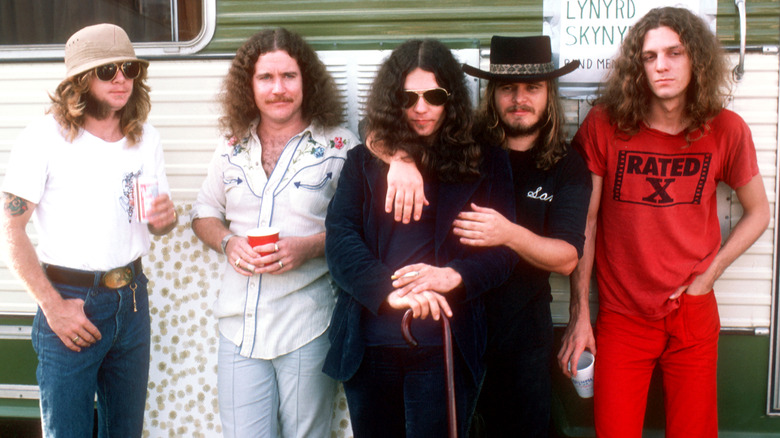
Lynyrd Skynyrd is among the most important rock bands of the 1970s, and it's also one of the more influential and original. Responsible for many of the songs that defined '70s Southern rock, the sprawling, Florida-based collective combined many different kinds of all-American music to create something altogether new and exciting, a simmering and ever-evolving concoction of a sound. Originating as a high school band, Lynyrd Skynyrd got its name from an adversarial gym teacher and for most of the '70s, gigged around in increasingly large venues playing songs about good times, good friends, and personal exploration, all driven by the alternately soaring and gritty vocals of original frontman Ronnie Van Zant and the sting of several guitars.
Several events in Lynyrd Skynyrd's tragic real-life story prematurely cut off the band's potential impact, but it still made a major impression on 1970s music and beyond. Here's the history of Lynyrd Skynyrd, from the '60s to the present, as told through its work, art, and legacy: its most important songs.
Need All My Friends
Before it adopted the name Lynyrd Skynyrd, the collective of musicians in their early 20s was finding its sound as the One Percent. The group was gaining such a following in and around its hometown of Jacksonville, Florida, that in 1969, a local music store manager arranged studio time for the One Percent. That would give the band something to sell to fans and also to pitch to radio stations, potentially elevating its profile by taking its sound to the masses. Invited to record two songs at Norm Vincent Studios, frontman Ronnie Van Zant selected the shortest, most radio-friendly tunes in the group's repertoire. Along with "Michelle," written about the singer's young daughter, the One Percent recorded "Need All My Friends."
In between putting its two tracks to wax and when the records were ready for public distribution — about 300 copies were produced by the tiny Shade Tree Records label — the band changed its name. The records were attributed to Lynard Skynard, so it hadn't settled on a spelling quite yet. With everything in place, "Need All My Friends" was the first step on the road to a record deal for what would eventually be known as Lynyrd Skynyrd.
Down South Jukin'
Most fans never heard "Down South Jukin'" until after the tragedy-inspired demise of Lynyrd Skynyrd in 1977. It's the initial track on "Skynyrd's First and ... Last," a compilation of the group's little-heard, obscure, and very first recordings. As heard there, "Down South Jukin'" is little more than a demo, recorded at Alabama's legendary Muscle Shoals Sound Studios, and it's an interesting artifact for hardcore Lynyrd Skynyrd aficionados.
Before it would acquire the polish and confidence that come with time and experience, Lynyrd Skynyrd's sound was a bit rough. Written by guitarist Gary Rossington and singer Ronnie Van Zant, it's a bit of juvenilia, but the promise of what's to come is there, with some clever musical motifs and lyrical turns of phrase. It's also one of the few places where early (and way in the future) member Rickey Medlocke, later of the '70s rock band Blackfoot, can be heard. "Down South Jukin'" is the work of a band in progress, about to emerge with a signature sensibility.
Gimme Three Steps
In the 21st century, "Gimme Three Steps" is one of Lynyrd Skynyrd's most-streamed and listened-to songs, but when it was first released as the lead single off of the band's first publicly released album, 1973's "Pronounced Leh-Nerd Skin-Nerd," it didn't get much traction at all in terms of sales or chart placement. What it did do, however, was announce the arrival of Lynyrd Skynyrd, as "Gimme Three Steps" is an encapsulation of everything the group would bring to rock music, both the old-fashioned and the innovative, in the years to come.
Lyrical realism resonates with listeners, and Lynyrd Skynyrd maintained that by pulling from true life events for story songs with wild plots. "Gimme Three Steps" is based on a bar encounter experienced by member Ronnie Van Zant. "He had started dancing with this chick and this guy came in and was going to beat him up and Ronnie said, 'Just give me three steps and I'm gone.' The guy had a gun and he was a redneck and he was drunk — a nasty combination of things — and Ronnie said, 'If you're going to shoot me, it's going to be in the a** or in the elbow.' And he took off like a bat out of hell," Gary Rossington told Guitar World. The roguish, impish, boozy lyrics meshed perfectly with Lynyrd Skynyrd's boogie-down sound, mixing country, blues, and Americana with the grimiest of rock. "Gimme Three Steps" was the template for future Lynyrd Skynyrd highlights moving forward.
Sweet Home Alabama
Lynyrd Skynyrd's first hit song was the leadoff track on its second album, 1974's "Second Helping." And that tune was "Sweet Home Alabama," the one and only Skynyrd song to ever reach the Top 10 on the pop chart. A watershed moment for the band, "Sweet Home Alabama" is also as much of a thesis statement as there could ever be for Lynyrd Skynyrd and its sound, as it embraces and exudes the basic elements of Southern rock.
It's so blatantly Southern, and full of lyrical Southern pride for Alabama, a state from which Lynyrd Skynyrd didn't actually originate, because it's also a response song and a diss track. Lynyrd Skynyrd certainly garnered attention and curiosity for "Sweet Home Alabama" once it came out that it was a pointed counterpoint to two Neil Young songs that took a dim view of the South and its denizens: 1970's "Southern Man" and 1972's "Alabama." And so, Lynyrd Skynyrd, all huge Young fans, came up with "Sweet Home Alabama," which namechecks the singer-songwriter and one of his offending works: "Well I heard Mr. Young sing about her (Southern man), well I heard ol' Neil put her down. Well I hope Neil Young will remember: A Southern man don't need him around, anyhow."
Free Bird
Of the finite canon of 1970s classic rock songs, some of the most celebrated and most enduring are the grand, ambitious, multi-part song suites. These are the lengthy and epic anthems that defined a decade and a generation of rock: "Layla" by Derek and the Dominos, "Bohemian Rhapsody" by Queen," "Stairway to Heaven" by Led Zeppelin, and "Free Bird" by Lynyrd Skynyrd.
Probably the band's best-known or even most infamous song, "Free Bird" both is and isn't the Southern rock that Lynyrd Skynyrd helped create and spread. The characteristic bluesy twang is there in both the main guitar melody and the lead vocals, but "Free Bird" is also as propulsive and hard-rocking as anything a non-Southern band would crank out in the '70s, particularly the final section of the song, a showcase of the expert, rapid-fire guitar work of multiple instrumentalists in Lynyrd Skynyrd. Not only that, but the lyrics, about a man who can't be tamed or transformed, just beg for an audience singalong. A Top 20 pop hit in 1975 that became Lynyrd Skynyrd's eternal concert-closer, it's the song that solidified the band's status in the rock pantheon. It's also the inspiration for the tradition of shouting out "Free Bird" at concerts.
Saturday Night Special
Partying down with each other, attracting women, expressing pride in Southern identity, and just plain rocking out: These were the themes and tropes that defined the early sound of Lynyrd Skynyrd, and which made it one of the biggest bands of the mid-1970s. "Saturday Night Special" demonstrated that the group's songwriters — Ronnie Van Zant, Allen Collins, and Gary Rossington — could write songs with more complex lyrics and difficult themes.
"Saturday Night Special" takes an explicit stance against gun use and ownership. Socially conscious, politically motivated music wasn't all that widespread in 1970s rock, particularly not ones about such hot-button issues. Appearing on Lynyrd Skynyrd's third studio album, "Nuthin' Fancy," "Saturday Night Special" sounds like a typical song by the band, notable for its signature multi-guitar sound. The lyrics, however, poke holes in macho archetypes, deriding men who take a brutal, shoot-first-ask-questions-later approach and arguing that guns serve no purpose besides being murder weapons.
It also marked a commercial turning point for "Lynyrd Skynyrd." A top 30 hit in the summer of 1975 (and the band's first after "Free Bird"), "Saturday Night Special" enjoyed major exposure when it appeared on the soundtrack of the hit Burt Reynolds movie "The Longest Yard," the inclusion of which was pre-arranged by the band's management before the song had even been recorded.
What's Your Name
Lynyrd Skynyrd's 1976 album "One More From the Road," captured and perpetuated the band's magical acumen for live performance. Essentially a greatest hits album, the live LP certified for sales of three million units. After slowly moving out of an existence as a moderately popular fringe act, it had risen to the upper echelon of the biggest bands in the United States. The future of Lynyrd Skynyrd hinged on the reception and performance of its direct follow-up to "One More From the Road," and that would turn out to be the 1977 album "Street Survivors." The first single and the lead-off track on the record was "What's Your Name," a gritty, groovy, danceable jam, which, like "Gimme Three Steps" and "Sweet Home Alabama," pulled from reality.
The song is set in Boise, Idaho, a nod to a tour-starting show by .38 Special, an up and coming Southern rock band that featured Lynyrd Skynyrd singer Ronnie Van Zant's brother Donnie. Other than that, "it's all basically a true story," Gary Rossington told Guitar World. "One of our road crew got in a fight at a bar with one of the hotel guests and they kicked us out, and we said we'd leave if they'd send a bottle of champagne to our room. It's just about being young and free." Audiences loved the vibes, and they sent the song to No. 13 on the pop chart, Lynyrd Skynyrd's second-biggest Hot 100 placement ever.
That Smell
Generally speaking, throughout the 1970s, Lynyrd Skynyrd had two speeds: fun and epic. With "That Smell," the group showed off a little-seen dark side. Lynyrd Skynyrd lead singer Ronnie Van Zant wrote the song as a warning to friends, expressing a foreboding sense of bad things to come. He would turn out to be correct about the horrific events that would soon affect the band.
"That Smell" appeared on "Street Survivors," the final Lynyrd Skynyrd studio album of the 1970s and one of the final pieces of music generated by Van Zant. It was conceived some time before it was perfected for release in 1977, following several concerning events involving band members Gary Rossington, Allen Collins, and Billy Powell. "I wrote that song when Gary had his car accident. It was last year, and Allen and Billy also were in car accidents, all in the space of six months, so I had a creepy feeling things were going against us, so I thought I'd write a morbid song," Van Zant said in an interview (via "Classic Rock Stories").
You Got That Right
Lynyrd Skynyrd reunited in the 1980s and would persist into the 1990s and beyond, but the first and most special period of the band ended abruptly on October 20, 1977. A small plane transporting the band to a gig malfunctioned and fell into a swamp in Mississippi. Both pilots died in the crash, as did the group's assistant road manager, backing singer Cassie Gaines, guitarist Steve Gaines, and lead singer and creative leader Ronnie Van Zant.
Only three days earlier, Lynyrd Skynyrd had released "Street Survivors," a masterpiece that includes some of its most-loved songs and became a de facto and inadvertent final statement from Van Zant. Gaines and Van Zant wrote "You Got That Right" together, and it was one of the last songs that the '70s incarnation of Lynyrd Skynyrd recorded. Issued as a posthumous promotional single in April 1978, "You Got That Right" peaked at No. 69 on the pop chart.
Truck Drivin' Man
After a 1977 plane crash claimed the lives of several members of the band, it took survivors a full decade before they were ready to regularly perform again as a unit under the Skynyrd name, all at the behest of Gary Rossington. He organized at first a single show, which demand ballooned into a 30-show 1987 reunion tour, not to commemorate or memorialize anything, but to pay tribute to deceased bandmates. Replacing Ronnie Van Zant on lead vocals in the reformulated Lynyrd Skynyrd: his own brother, Johnny Van Zant.
Finding it hard to operate without its original singer, Lynyrd Skynyrd invited in guest vocalists for some songs while performing "Free Bird" as an instrumental, allowing the audiences to sing the words in unison. The reunion also launched a newly created Lynyrd Skynyrd collection called "Legend," made up of obscure and never-released recordings. A highlight: "Truck Drivin' Man," the first new Lynyrd Skynyrd song since the late 1970s, although it was actually an old recording of a song featuring Ronnie Van Zant. The fans responded positively, and it reached No. 12 on Billboard's rock chart. "Truck Drivin' Man" ultimately proved that Lynyrd Skynyrd wasn't done yet, and that its stature and popularity had certainly increased since it disbanded.
Smokestack Lightning
Encouraged and emboldened by a successful reunion tour and solid sales of its rarities collection "Legend," Lynyrd Skynyrd made its brief late 1980s reformation a permanent thing. Since regrouping, Lynyrd Skynyrd has released far more studio albums than it did during its first and peak era in the 1970s.
The band's second era as a viable recording act began with the album "Lynyrd Skynyrd 1991" in 1991. With respectable Ronnie Van Zant replacement Johnny Van Zant on vocals and four golden-age members (Gary Rossington, Leon Wilkeson, Ed King, and Billy Powell) on board, the new Lynyrd Skynyrd sounded a lot like the old Lynyrd Skynyrd. Opting to not try to sound like one of the many hair metal, hard rock, or grunge bands vying for radio play in the early 1990s, the group made it sound like it had never really gone away. The debut single from "Lynyrd Skynyrd 1991" was "Smokestack Lightning," a piano-based, rapid-paced boogie-blues bar song. Despite sounding nothing like what was hip at the time, "Smokestack Lightning" was a smash, peaking at No. 2 on the rock chart.
Red White and Blue
Lynyrd Skynyrd played a major role in shaping Southern rock, which in turn helped inspire modern mainstream country music. By the early 2000s, the band calling itself Lynyrd Skynyrd — which only included two musicians involved with the group in the mid-1970s — had embraced the sound of the musicians it had helped inspire. Masculine, party-loving "bro country" singers and country-infused rock acts like Kid Rock were the 21st-century versions of Lynyrd Skynyrd, and in 2003, the legendary band's final original material sounded just like that of those musicians.
In 2003, Lynyrd Skynyrd was one of many well-known acts to release sentimental, unabashedly and aggressively patriotic songs, part of the cultural response to the terrorist attacks on American soil on September 11, 2001. Alongside Toby Keith's "Courtesy of the Red, White, and Blue" and Alan Jackson's "Where Were You (When the World Stopped Turning)" came Lynyrd Skynyrd's "Red White and Blue." A celebration of stated American values like pride in family, work, and nation, the anthemic song anchored "Vicious Cycle," the last major album release by Lynyrd Skynyrd before a series of barely distributed records and live albums and a settling into the casino and county fair nostalgic performance circuit. The death of last remaining original member Gary Rossington in 2023 means the band labeled Lynyrd Skynyrd no longer has any connection to its heralded past, bringing the tangled history of Lynyrd Skynyrd into what's likely its final chapter.