

These 5 Killer Guitar Solos Are Imprinted On True Classic Rock Fans For Life
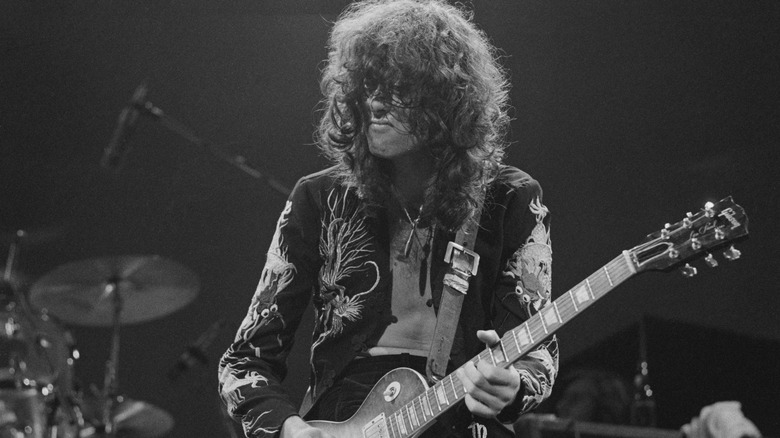
Guitar solos kick ass, right? They got the bends, the shrieks, the licks, the wahs, the taps, the pained orgiastic facial expressions, and can skyrocket a song to emotional zeniths unattainable within the confines of an otherwise droll, daily existence. And since the "golden era" of classic rock (1964 to 1982) delivered unto us banger rock songs that we'll be blasting on repeat 'til the day we die, it stands to reason that some of those songs contained killer solos that have been seared into the very souls of true fans for life. And yes, this is indeed the case.
In selecting some of those killer classic rock solos, we already defined the era of time that we're pinpointing: classic rock's heyday and not just "classic rock" as a byword for "old rock." As for what defines a killer solo, well, that could be a lot of things. The best solos gather a song's story, rephrase and reiterate it, and act as the culmination of an entire musical piece. A solo can be a total shredfest, it can be melodic and hummable, it can be short or long — whatever. But in order to be imprinted for life, it's likely got to be a prominent song that folks have heard again and again and can cite note for note.
On that, er, note, we've settled on a couple of obvious choices, like the epic solos from "Free Bird" and "Hotel California" by Lynyrd Skynyrd and Eagles, respectively, as well as the equally legendary solo from Led Zeppelin's "Stairway to Heaven." Add to these a no-brainer choice from Pink Floyd and perhaps a surprise choice from Dire Straits, and we've got enough superb, varied solos to shred in your head for life.
Free Bird — Lynyrd Skynyrd
How could we not start our list with a song that's basically one-half solo? Yep, it's time for the high-flyin', whirlin', and swoopin' dual-guitar sweetness of "Free Bird" by Lynyrd Skynyrd. The song comes from the band's 1973 debut album, and helped define Southern rock in the '70s right down to the revelrous admission of self-destructive tendencies: "Bye-bye, baby, it's been a sweet love, yeah, yeah / Though this feeling, I can't change / But, please, don't take it so badly / 'Cause Lord knows I'm to blame." We say "revelrous" because without the solo, "Free Bird" sounds wistful and forlorn, like the song's speaker leaving for the road. With the solo, however, "Free Bird" sounds as bold and free as its name implies.
The solo for "Free Bird" isn't just awesome because of its melodicism, its harmonically-linked double guitars, its memorable key moments, and yes, its length. Whether listeners consciously realize it or not, "Free Bird's" solo works so well because it tells a story. Not just any story, mind you, but the perfectly-suited, extended coda to the song's lyrical tale that fades out just like a car or motorcycle down the highway fades from sight.
And of course, the solo's length definitely helps it stand out and stick in memory. Skynyrd guitarist Gary Rossington told Ultimate Classic Rock that "Free Bird" was originally just its first half, i.e., a slow, "real simple love song." But over time, as the band jammed together, the song grew and grew into its final, liberated form. Cheers to putting the effort in, guys. Now we've got one of rock's most classic solos from one of its most classic songs.
Hotel California — Eagles
Next, we've got a song that's only one-third solo instead of one-half solo, but one which is no less burned into the minds of true fans ad infinitum. The solo for Eagles' "Hotel California" off their 1976 album of the same name is so iconic and masterfully phrased that even casual listeners might be able to hum the whole thing along with diehards. Should we expect anything less from the lead song from an album that's the top-selling album ever in the U.S. and the second top-selling album of all time, worldwide?
In a nutshell, "Hotel California's" solo works so well because every note is clearly intentional, right down to the articulations (how it's played) on top of the composition (how it's written). There's no aimless fretboard noodlings, no cocky nonsense that focuses on style over substance, and nothing to yank the listener out of the song's core melodic loop. The solo begins with a single guitar playing over the song's verse progression, then takes off once the second, harmonizing guitar joins for the solo's iconic arpeggio section. And much like "Free Bird," the solo fades out at the end, implying that the tale of "Hotel California" — possibly a hidden meaning about the trap of fame — isn't over.
All of this musical wizardy came straight from the original instrumental demo of Don Felder, aka, one of the Eagles' many former members in a band frought with endless lineup changes. Buoyed by Don Henley's fantastic lyrical storytelling — "Cool wind in my hair / Warm smell of colitas / Rising up through the air" — Felder teamed up with fellow Eagle Joe Walsh for the studio version we all know and love.
Stairway to Heaven — Led Zeppelin
It might seem too obvious to choose the solo from a song like Led Zeppelin's "Stairway to Heaven" for this article, but who are we to argue with such a memorable work from such a key classic rock outfit? Released as a non-single on the band's 1971 album (technically left without a title, but often called "Led Zeppelin IV"), "Stairway to Heaven" grew to its current, iconic status, solo and all.
As Zeppelin guitarist Jimmy Page told Classic Rock magazine, the solo for "Stairway to Heaven" kind of just happened. He went in at the end of the song's tracking to do his overdubs, picked up the Fender Telecaster that he called a "magical guitar" (a gift from Jeff Beck), and after a couple of failed attempts, the whole solo basically flowed like a "stream of consciousness." A true solo in an improvisational sense, Page said that he adjusted and altered it in live performances, but kept the core musical thread.
Page's story explains everything about how the solo for "Stairway to Heaven" feels. The solo is organic and integrated into the song, but also feels spontaneous, like Page had the song's flow and progression 100% locked in place in his mind when he recorded his parts. The solo also fuses with "Stairway to Heaven's" chapter-based, sequential structure and bleeds into its bridge, marked by Robert Plant's "And as we wind on down the road / Our shadows taller than our soul" lyrics. Finally, the solo has this groovy, shuffle feeling (alternating long/short rhythms) that plays marvelously off "Stairway to Heaven's" rhythm guitars. Yeah, it's a masterwork for a reason, one that no true fan will likely ever soon forget.
Comfortably Numb — Pink Floyd
Sometimes the best solos are the ones that are the most pared-back. Such is the case with guitarist David Gilmour's solo for Pink Floyd's "Comfortably Numb" from 1979's "The Wall." The solo oozes passion and feeling. It follows the most straightforward of blues-rock progressions and does so in a way that shows you how much can be done with so little. It's a triumph of emotion over flash.
As Gilmour told Guitar World, he approached his solo for "Comfortably Numb" with his usual, methodical, architect's process. He played a handful of different solos over the song, listened to each one, plucked out the best parts, and stitched together the final version. The result is a solo that's perfectly synced with "Comfortably Numb's" G major-E minor-B minor line, builds over time, finds new articulations, rhythms, and accents along the way, and ends on a series of high notes that almost sound like a voice in pain. This is a perfect compliment for the character Pink's drug-addled tragedy described in the song's lyrics ("I cannot put my finger on it now / The child is grown, the dream is gone").
Interestingly, just like "Free Bird" and "Hotel California," the solo for "Comfortably Numb" comes at the very end of the song and fades out along with it. This technique leaves something about the song feeling unresolved and makes the listener want to hear it again. This, in turn, makes the whole song and its solo more likely to stick in memory. Kudos, Gilmour and company. There's a reason Pink Floyd is one of the most successful rock bands of all time and had the highest-selling album of the '70s, 1973's "Dark Side of the Moon."
Sultans of Swing — Dire Straits
Finally, we end on an odd and memorable solo from a band that's just as odd and memorable: "Sultans of Swing" from Dire Straits. Even though Dire Straits arguably reached their peak of fame and success with 1985's "Brothers in Arms" (and ended for good seven years later in 1992 because they burned out), Dire Straits had roots in our "golden era" of classic rock (1964 to 1982). A mere year after they formed in 1977, they released their 1978 self-titled album and its megahit, "Sultans of Swing," jangly solo and all.
Unlike most of the other entries in this article, the solo on "Sultans of Swing" is short and sweet (about 30 seconds long). But it makes every note stand out and is a testament to the brilliant songwriting of guitarist and singer Mark Knopfler. Throughout the solo, Knopfler's unusual, signature fingerpicking and vibrant, absolutely clean guitar tone rephrases "Sultans of Swing's" main instrumental line, which itself is one of Dire Straits' characteristically compact, ultra-catchy musical loops. The result is a jaunty, accessible, boppy, even fun solo that feels exactly like what inspired "Sultans of Swing:" a night out when Knopfler watched a house band play to "an audience of three or four" in a pub, as Ultimate Classic Rock quotes.
As far as songwriting is concerned, "Sultans of Swing" is a case of how "the music you make is shaped by what you play it on," as Guitar World quotes Knopfler. He thought the song was "dull" until he bought a 1961 Fender Stratocaster that changed everything about how "Sultans of Swing" felt, right down to the solo's vibrato that comes out through his fingerpicking.