

5 High School Hits From The '60s That Will Stir Up Emotions In Every Boomer
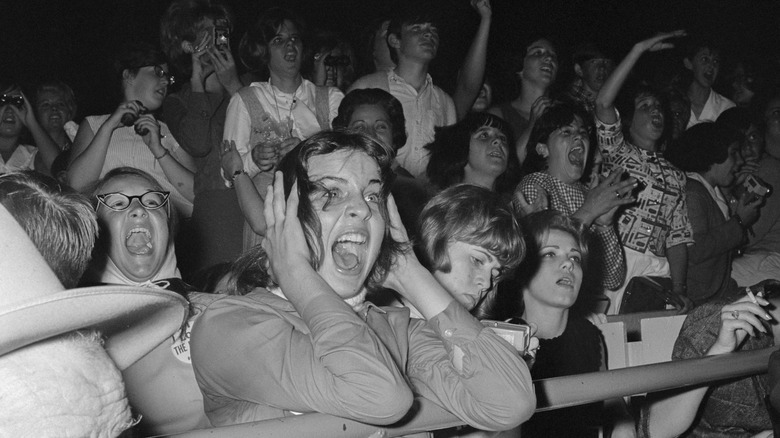
For some teenagers in any decade, high school is something to be endured before being left behind as fast as possible. For others, it is an impactful, formative period, and a positive experience. Some meet their future spouses, and many make friends that will last lifetimes. In the 1960s, high school kids' education wasn't just restricted to the classroom. Alongside learning math and history, they were immersed in some incredible music that has given boomers the ultimate bragging rights.
Many of the monster hits of that decade — and there were hundreds — have stood the test of time largely because they made such a profound impression on high schoolers. Teenage audiences helped send songs to the top of the charts, and as grown ups, boomers have continued to cherish these songs.
The music became the subject of endless discussion between fellow fans, high school sweethearts bonded over it, and hit singles provided a springboard for carefully curated album collections and sparked passions for entire musical genres. We've chosen just a handful of tunes from the '60s that we think will instantly whisk boomers back to high school years and give them all the feels.
To Sir, With Love — Lulu
Scottish singer Lulu was already a star in the United Kingdom, thanks to the infectious 1964 hit "Shout," but she would achieve global fame three years later with the gentle ballad "To Sir, With Love." Part of the soundtrack to the film of the same name, starring Sidney Poitier and, at the opposite end of the cast list, a teenage Lulu, the song was a farewell to someone who had become a beloved teacher.
Created from a melody by Mark London and paired with Don Black's heartfelt lyrics, "To Sir, With Love" came together in just a couple of days, but its impact was enormous. It put into words the crushes of millions of high-schoolers on their teachers, who were witnessing their transition "from crayons to perfume," while the teenagers (raging bags of hormones that we all were) could sing the lines: "If you wanted the moon / I would try to make a start / But I would rather you let me give my heart."
With the benefit of 21st-century, grown-up hindsight, those lyrics might seem a little problematic, but they weren't in 1967. "To Sir, With Love" was a No. 1 hit in the United States for five weeks. Parents whose kids were swooning over their high school teachers saw it as mild stuff, compared to controversial songs released just a couple of years later. Boomers hearing Lulu's lovely ballad today can fondly reminisce about our childhood innocence and tender, first experiences of love.
I Want to Hold Your Hand — The Beatles
It is impossible to underestimate the seismic impact John, Paul, George, and Ringo had not only on the music world, but on the 1960s' high schoolers who first heard the Liverpudlian quartet. Created specifically to help the band break into the North American market, "I Want to Hold Your Hand" succeeded beyond their manager Brian Epstein's wildest dreams, spending seven weeks atop the Billboard Hot 100 in 1964.
The Lennon-McCartney composition was simple in its sweetness, and teenagers across the United States ate up every word. For every tongue-tied kid at a high school dance or prom, the lyrics offered a poetic way to tell that certain someone how you felt; the song's bubbly refrain transformed into the most earnest of requests.
Boomers who were lucky enough to see the Fab Four play live in their early years were able to scream along to the chart-topper. If we didn't realize right then the mythic status the Beatles would later achieve, we knew this band had gotten their hooks into us, and we were in it for the long haul. Fast forward a few decades, and some insist "I Want to Hold Your Hand" is actually edgier than its innocent lyrics suggest. Der. Why do you think we loved it?
White Room — Cream
It's easy to imagine that the '60s were all sunshine and flowers for high schoolers, but there were plenty of us who were frustrated, confused, or just plain sad about life. The decade's plethora of pop music may not have provided any outlets, but Eric Clapton, Jack Bruce, and Ginger Baker, who formed supergroup Cream, definitely did.
"White Room" was the opening song on the prog rock band's 1968 double album "Wheels of Fire," and reflected Pete Brown's emotional turmoil about whether to continue penning song lyrics or return to poetry. Written in an actual white room, the song reads more like an abstract poem than a set of lyrics, but for anyone experiencing difficult periods in their life (and sometimes life didn't get any more difficult than high school), it was the perfect soundtrack.
It also showed that all was not lost. "I walked into such a sad time / At the station / As I walked out, felt my own need / Just beginning." Boomers who managed to overcome their personal trials and tribulations can listen to "White Room" with fresh, more optimistic ears, connecting with the feeling of hope that rises with Eric Clapton's guitar outro. Cream as a band may have only lasted a couple of years, but "White Room" is a gift that has kept on giving.
Whiter Shade of Pale — Procul Harum
Lots of bands scored hits with their first singles in the 1960s, and while most of them explored love, that wasn't the case for all of them. When Procul Harem's "Whiter Shade of Pale" hit stores in 1967, nobody could fathom what the heck it was about. Nonetheless, it became part of the eclectic soundtrack to the summer of love, and who didn't immediately fall in love with that looping organ?
Decades later, we're all still clueless about the story it was telling, or even if there was one to start with. We do know that composer Johann Sebastian Bach was the inspiration for the melody, thanks to Gary Brooker, and that "Whiter Shade of Pale" struck a chord with many high schoolers. "It came along at just the right moment, and meant so much to so many people at a formative time," he told Prog. "Now, younger people hear it and it still sounds full of atmosphere. It reflects an era that, perhaps, they wish they could have experienced."
We're sure plenty of boomers would agree with that assessment, but there's another, even better reason why we look back with such fondness on the four-minute track. Some of us remember our high school dances signing off with "Whiter Shade of Pale," the perfect slow dance (it was longer than your average radio pop song) to get close to the girl or boy of our dreams.
In My Room — The Beach Boys
"There's a world where I can go and tell my secrets to:" As first lines of songs go, The Beach Boys' "In My Room" was relatable to every high school kid who longed for their own space. Released as a B-side in 1963, it had all the essential ingredients of a Beach Boys tune: Gorgeous, multi-layered vocals and a delicious melody. But it was Brian Wilson's poignant, brave songwriting that went further than he could have even imagined.
We were blown away as youngsters by the intimate, incredibly personal lyrics — people just didn't say things like that in songs back then, and certainly not men. "In My Room" proved to high school music lovers that there was more to the Beach Boys than surfing and girls. That message would be reinforced three years later, with the release of the groundbreaking "Pet Sounds."
Listening to "In My Room" as an adult, the song gets a whole new shape. It's still a jewel in the crown of Wilson's songwriting, but it takes on another layer of meaning entirely when set against the backdrop of his mental health decline and experiences of drug addiction. We can let "In My Room" sweep over us like a wave and relish its elegance, while also remembering the very best of the man who created it.