

Real Classic Rock Fans Have These Power Ballads Tattooed On Their Hearts
William Shakespeare wrote, "If music be the food of love, play on," and never were truer words scribbled. Millions of songs have been dedicated to the subject, exploring it from every conceivable angle. Got a crush on a school friend? Donny Osmond's "Puppy Love" is the perfect singalong. Fallen in love after a romantic dry spell? Cue up Taylor Swift's "Fate of Ophelia." Been done wrong by your latest flame? Belting out "Silver Springs" along with Fleetwood Mac's Stevie Nicks will help you feel better.
Of all the genres churning out love songs a dime a dozen, rock has the best ballads by far. Even the perkiest pop ditty can't hope to compete with the ear-splitting growl of a guitar in heartbreak mode or a pulse of drums so loud you can actually feel them throb in your veins. Rock's power ballads aren't wallflowers and never belong in the shadows. They're bombastic declarations of our most primal emotions — good or bad — delivered full throttle. Look no further for the ideal celebration of a new romance or the perfect antidote to a broken heart.
Kiss — Forever
We're kicking things off with a song that divides Kiss fans firmly into two camps: Those who refuse to play it and those who cannot imagine a world without it. Of course, we're talking about "Forever," the 1990 single that catapulted the rockers into the Billboard Top 10 for the first time in over 10 years. It was a stripped-back version of the infamously over-the-top band in every sense: No makeup, an almost tender acoustic guitar bridge, and all of Paul Stanley's emotions laid bare for the world to see. At this point, the wrangles about who actually wrote the majority of the song (Stanley has repeated his claims that co-writer Michael Bolton's contributions were negligible) are ancient history. But the power ballad — and the sentiments behind it — has stood the test of time.
Until "Forever" came along, Kiss had only shown its softer side with the 1976 track "Beth," and Stanley's song serves less schmaltz and more sophistication. Although there are only two verses, the lyrics make clear that it's not talking about a flash-in-the-pan romance. The narrator has found their person, their perfect other half, and, in a moment of absolute vulnerability, they tell them they want to be with them for the rest of their lives. This isn't just a romantic song for the ages — it's an anthem for everyone who got the "I do" they were hoping for.
Heart — Alone
Who among us hasn't been on the verge of telling that special someone we can't get out of our minds that, er, we can't get them out of our minds? To have all that nervous energy bottled up, just waiting to be released when we finally confess our feelings to someone, hoping against hope that they feel exactly the same. That, in a nutshell, is the story of "Alone," Heart's soaring 1987 smash.
Originally written by Billy Steinberg and Tom Kelly, it made barely a ripple when initially released in 1983 and again the following year. However, in the hands (or more accurately, vocal cords) of Ann Wilson and rock band Heart, "Alone" became a fully fledged, timeless rock song about love. From the fragile piano bookends to Wilson's midpoint cry of utter anguish, it asks a question we all know has no satisfying answer.
Drums and guitars as big as the band's hair drive the knife deeper into our hearts as Ann's sister Nancy helps belt out the lines: "I never really cared until I met you / And now it chills me to the bone / How do I get you alone?" Despite the storm of emotions unleashed during the song, order is quickly restored, and we end up back where we started. Unlike the band's slightly creepy "All I Wanna Do Is Make Love to You," released in 1990, "Alone" remains a masterful exploration of unrequited love.
Guns N' Roses — November Rain
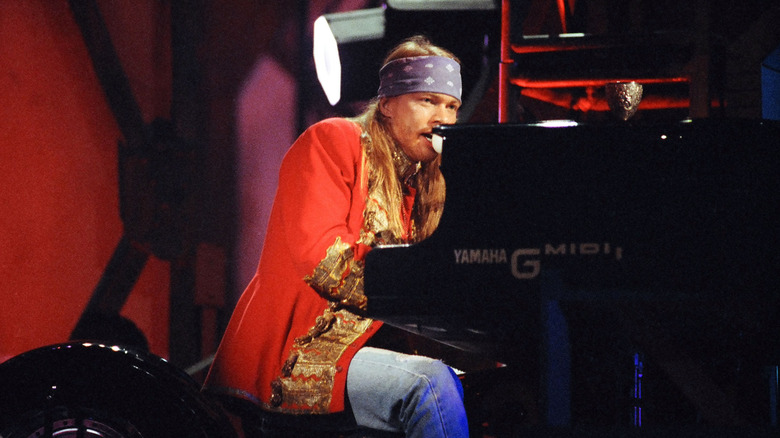
Where to begin with this eight-minute, 57-second monster of a rock ballad? Inspired by everyone from Elton John to Queen and Led Zeppelin, "November Rain" had its genesis in the early 1980s and was Axl Rose's "Mona Lisa." In 1988, Rolling Stone quoted him as threatening to "quit the business" if the track wasn't recorded to his satisfaction. He needn't have worried.
"November Rain" became the jewel in the double-album crown of 1991's "Use Your Illusion I and II." It was accompanied by a video that cost $1.5 million (roughly $3.6 million in 2026) to make and gave the ballad a story that hit hard. Slash may not have had a clue what "November Rain" was about, but Rose did, and that was good enough for us. For him, it wasn't just about unrequited love — it was about facing the reality of the situation, something that's often easier said than done.
Slash's multiple, exquisite guitar solos are a piquant counterpoint to Rose's increasingly beseeching lyrics. "So, never mind the darkness / We still can find a way," he sings as the outro looms before finishing the song with a plea: "Everybody needs somebody / You're not the only one, you're not the only one / Don't ya think that you need somebody?" As the last notes fade, we're reduced to emotional wrecks in puddles of mascara, wondering how long we can reasonably wait before dropping the needle again.
Meat Loaf — Two Out of Three Ain't Bad
Can you be a rock fan and not have a huge place in your heart for Jim Steinman's 1978 classic (written for Meat Loaf)? We don't think so. Apart from being an absolute banger, "Two Out of Three Ain't Bad" is almost unprecedented in its honesty, giving voice to a man who can't get over the girl who did him wrong all those years ago. The sting, of course, comes in the words she told him and what he repeats to the new woman vying for his affections: "I want you, I need you / But there ain't no way I'm ever gonna love you / Now don't be sad, cause two out of three ain't bad."
Anyone who has ever experienced rejection knows just how cruel Steinman's attempt at a gentle let-down is. Being told you're wanted and needed is great, but not when love's off the table, and the throwaway line that inspired the song's title is the ultimate killer blow. "Two Out of Three Ain't Bad" gave commitment-phobes an anthem and proved that Steinman could write a hit song that wasn't a seven-act opera.
That relative simplicity means the song's barbed heart can be driven home with ultimate effect. Though it only reached No. 11 on the Billboard chart, this bittersweet love song is an enduring favorite among fans. Steinman pulled off a similar bait-and-switch with the overblown 1993 ballad "I'd Do Anything For Love (But I Won't Do That)."
Pat Benatar — We Belong
At a whisker over 5 feet tall, Pat Benatar may be tiny, but she's a true rock giant (even though she flirted with the idea of being an opera star). By 1983, she had multiple awards to her name, thanks to hits like "Hit Me With Your Best Shot" and "Love Is A Battlefield." But then she released a song that makes classic rock fans' ears prick up, no matter where they are or what they're doing. "We Belong" has all the ingredients of a top-drawer power ballad: Poignant lyrics that say more in a handful of words than us mere mortals ever could, a thumping drum track, and — of course — a choir of children.
Released in 1984, it climbed to No. 5 on the Billboard Hot 100 the following year and helped cement Benatar's reputation as a queen of rock. More importantly, "We Belong" gave us a way to reach out when a relationship frays at the edges. "Have we become a habit? / Do we distort the facts? / Now there's no looking forward / Now there's no turning back" could easily echo a long-standing marriage teetering on the brink of collapse. But the song wasn't originally inspired by romantic love, and that's what really makes it special.
When songwriters Eric Lowen and his best friend Dan Navarro fell out after the latter was booted out of their band, they didn't speak for almost two months. When they agreed to meet up again and write a song, Navarro said he was "kind of lamenting an old relationship," per The Tennessean. Within a couple of hours, "We Belong" was written.
Bob Seger — We've Got Tonite
British rock fans might wrinkle their noses at the American spelling in veteran musician Bob Seger's ballad, but it's a small gripe about an otherwise majestic song. In a clip posted to his Instagram, the singer said he was inspired by a scene in the 1973 movie "The Sting," saying the notion of someone being alone in a big city and finding comfort with a stranger was "cool." In the hands of lesser songwriters, the lyrics to "We've Got Tonite" might seem seedy or tawdry, but thanks to Seger's skill, we can feel the ache in every word. "I know your plans don't include me / Still here we are / Both of us lonely (lonely), both of us lonely (lonely)," he sings. The protagonist at the centre of his tale doesn't presume anything untoward is going to happen — they're simply seeking the solace of another human being.
But the reason "We've Got Tonite" has become a classic rock ballad is because it works for would-be lovers too. As the song builds, Seger's growled vocals threaten to crack and break, offering a glimpse at the raw yet fragile emotions beneath. Would we, like some, choose it as a wedding first dance song? Perhaps not. Does it still pack a romantic punch? Absolutely.