

Bizarre Secrets Behind History's Most Famous Funerals
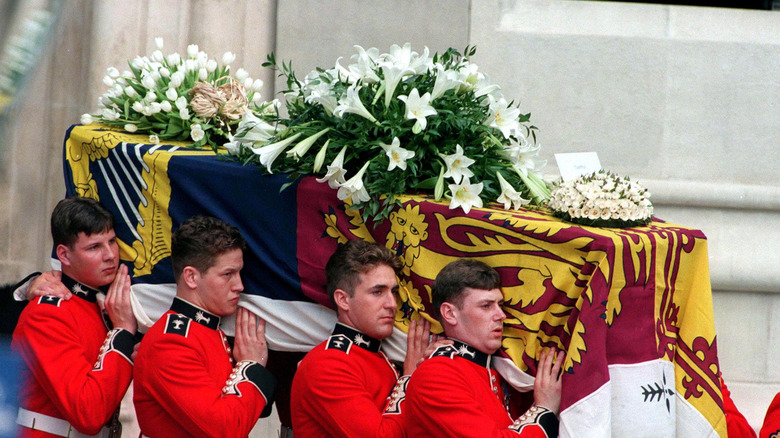
A funeral is merely a collection of long agreed-upon rituals to honor the recently deceased. And, upon just a little examination, those processes can seem quite interesting or just plain weird. But when a famous person dies — be it a celebrity, head of state, important leader, or beloved cultural figure — those rites, practices, and dutifully honored final wishes of the dead get all the bigger and more obviously curious or even absurd. Sometimes, those things are kept secret for as long as possible.
When those individuals we deem to be the most important die, their funerals and memorial services become centerpieces in mass public grieving movements. They attract huge crowds and can generate a lot of spectacle. But the real story is in the details — those little elements that make those sedate state funerals or stadium-filling celebrity tributes truly memorable and historical. Here are the inside stories regarding some of the biggest funerals ever staged and what made them all extremely unique.
Josef Stalin
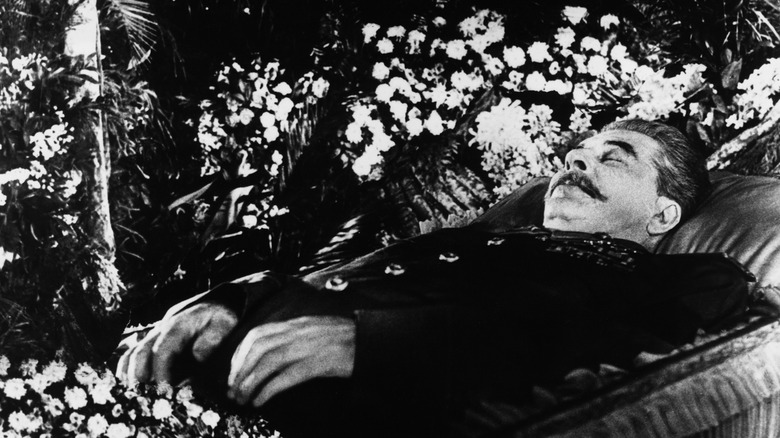
At the height of the Cold War, the USSR's propaganda machine was sophisticated and unrelenting. So much so that the millions of people who lived in the socialist empire had little to no idea that their longtime dictator with a cult of personality, Josef Stalin, was anything less than perfect. In fact, he was quite monstrous — an estimated 27 million people died as a direct result of his actions. But all the murder, starvation, untoward imprisonment, and war death were so carefully buried that when the leader died in March 1953, it was a national tragedy characterized by profound, collective grief.
One day after Stalin died of heart and lung failure, his body was placed in an open casket and lay in state for a period of three days in the Hall of Trade Unions in Moscow. On March 9, the body was sent to Red Square to be buried next to that of a previous communist hero, Russian Revolution leader Vladimir Lenin. During the public display of Stalin's body, it was legitimately documented that a steady stream of thousands of deeply saddened Soviets attended the viewing. So many, in fact, that the Hall of Trade Unions couldn't handle the crowds. A number of people were crushed to death, but owing to the tightly state-controlled media, it's impossible to know how many mourners died. The next head of the USSR, Nikita Khrushchev, claimed that exactly 109 people died. Other, non-Soviet sources placed the number in the thousands.
Dr. Martin Luther King Jr.
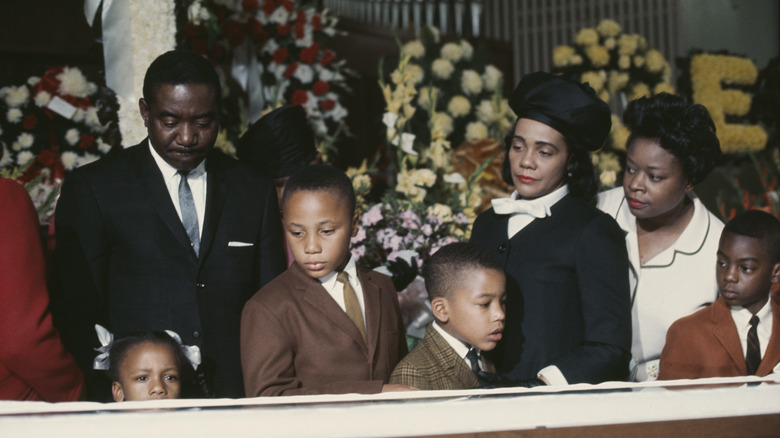
On the evening of April 4, 1968, Civil Rights Movement leader Dr. Martin Luther King Jr. was in Memphis to show his support for a local labor strike. As he stood on the balcony of his motel room, he was shot from a distance. He was pronounced dead just over an hour later.
The tragic and shocking murder of the greatly admired leader and agent of profound change was succeeded by a large funeral befitting such an individual. An estimated 200,000 people took part in a solemn march through the streets of Atlanta that concluded at Ebenezer Baptist Church, where he'd served as a pastor for nearly a decade. The building couldn't hold the massive crowd, but 60 members of Congress, President Richard Nixon, and cultural icons like singers Harry Belafonte and Mahalia Jackson were seated.
Remarkably, one eulogy was delivered by King himself. In February 1968, two months before his death to the day, King gave a sermon called "The Drum Major Instinct" at that very church. The leader wondered about what his own funeral would be like. Per The Martin Luther King Jr. Research and Education Institute, he said he wanted to be memorialized as a man devoted to service — "a drum major for justice" and "a drum major for peace." Parts of the recording of that sermon were played at the memorial service.
Princess Diana
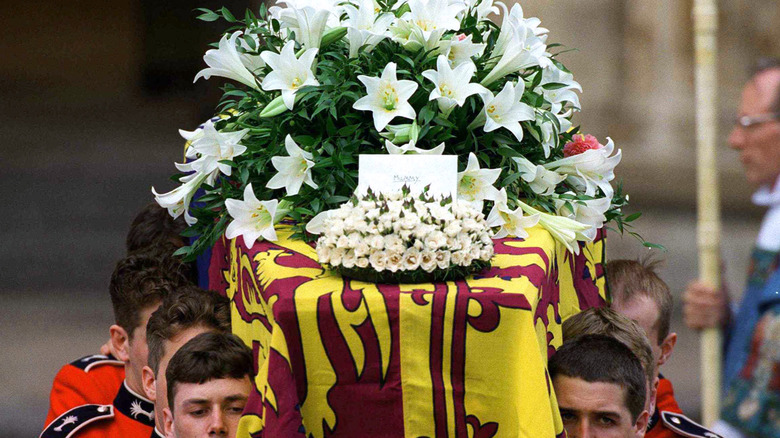
Princess Diana's death permanently changed the U.K. royal family. The lead-up to her funeral after a fatal traffic accident in August 1997 was a trying and grisly ordeal. Diana was pronounced dead at the Pitié-Salpêtrière Hospital in Paris, and her butler, Paul Burrell, and security consultant, Colin Tebbutt, arrived hours later. The body had been placed in a first-floor room in an emptied emergency ward, where the temperature was very high. After Tebbutt ordered blankets hung over the windows to prevent photographers from getting shots of the body, it only made the room even hotter. Knowing this heat would potentially speed up decomposition, Tebbutt placed a series of fans around the area. Hours later, Prince Charles and Diana's two sisters entered the room for private prayers and rites with two vicars, after which the body was taken out of the hospital in a coffin and draped with a royal flag. While that wasn't proper protocol because Diana was no longer technically a princess, Charles called for it nonetheless.
The funeral for Princess Diana was also treated like a royal matter, held in Westminster Abbey. Her lead-lined coffin was so heavy and ornate that in order to avoid ghastly errors, pallbearers had to rehearse with a practice coffin filled with enough concrete blocks to simulate the 700-pound casket. An estimated 2.5 billion people watched the September 6 funeral on live television, which included Diana's friend, Elton John, performing "Candle in the Wind," hastily rewritten with new lyrics about the late royal.
Jim Henson
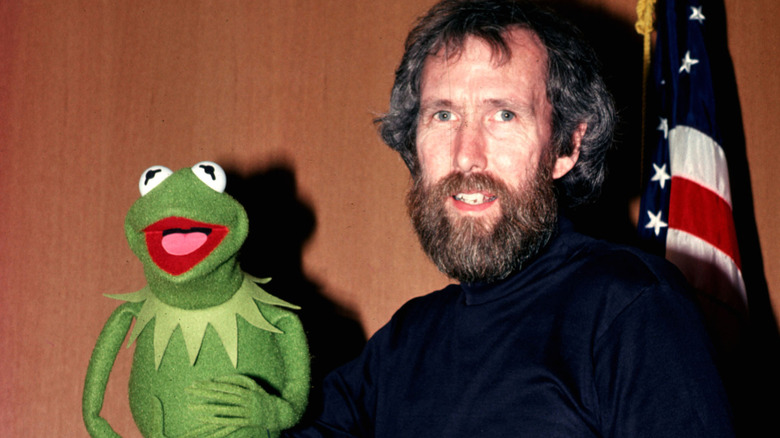
In May 1990, Jim Henson, creator and chief artistic mind behind the Muppets, died suddenly and unexpectedly from the effects of a bacterial infection at age 53. Nevertheless, he had codified his wishes well before his death, and his relatives, friends, and associates carried out his wish for a joyous service at the Cathedral of St. John the Divine in New York City just five days later. Jim Henson's five adult children each read letters written to them by their father, not to be opened until after his death. Brian Henson's note revealed that many of the service's most creative and whimsical elements had been the Muppet master's call. That included the presence of the Dirty Dozen, a Dixieland jazz band from New Orleans that concluded the funeral by playing and dancing out some of the 5,000 attendees.
Everyone at the service was given a simple puppet — a foam butterfly on wires that seemed to flutter its wings on its own accord. Also per Jim Henson's instruction: No one wore black, as he'd asked for people to wear bright, Muppet-style colors, like the vibrant green of Kermit the Frog, the puppet he operated and voiced. After a series of Muppet songs performed by Jim Henson's company members, Caroll Spinney, in costume and character as Big Bird from "Sesame Street," sang Kermit's signature tune, "It's Not Easy Being Green."
Abraham Lincoln
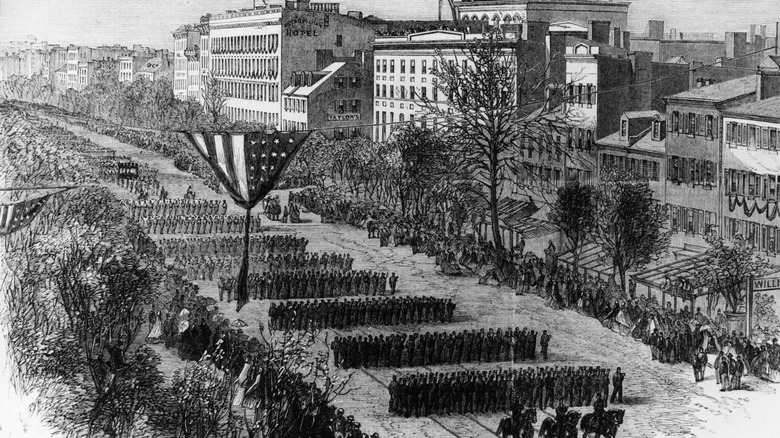
The life of Abraham Lincoln came to an end on April 15, 1865, after the president was fatally shot in Ford's Theatre in Washington, D.C., by John Wilkes Booth. The series of nationally spanning events that followed was such a massive and difficult undertaking that it earned a fitting nickname from writers of the age: "The Greatest Funeral in the History of the United States." The Civil War had effectively ended six days before the assassination, and a fractured and war-traumatized nation was united in mourning Lincoln.
The president's body embarked on a 20-day train tour of six states, with open-casket viewings in 13 cities, starting with periods of lying in state at the White House and U.S. Capitol in Washington, D.C. All told, residents of 180 cities were given a chance to see or be near Lincoln, and an estimated 10 million people — about one-third of the U.S. population at the time — seized the opportunity in some way. At the final stop in Springfield, Illinois, where the president was buried, 150,000 mourners attended, which was 10 times the city's population.
As Lincoln's casket had to remain open for 20 days' worth of viewings, the body had to be repeatedly embalmed. Dr. Charles Brown served as the undertaker, treating the body, which starts to decompose right away, before every viewing. Notably, he used embalming techniques perfected only a couple of years earlier during the Civil War.
Alexander the Great
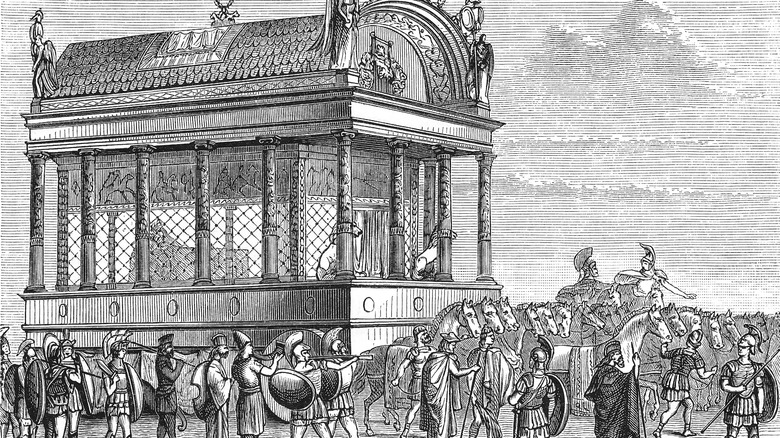
By the time he died at age 32 in 323 B.C., Alexander the Great of Macedonia had led his armies to conquer most of the known Western world at the time. As one of the most powerful, feared, and famous people on the planet, he was subsequently entombed in a sarcophagus made with a fortune's worth of solid gold. The coffin was so heavy and important that it had to be pulled by 64 mules, and the funeral procession lasted for years, covering thousands of miles of the ancient world.
Alexander's body remained in Babylon for two years, remaining in a moveable mausoleum until Perdiccas, a general of Alexander and high-ranking member of the Macedonian government, told the procession to head for Anatolia, where he was headquartered. By hosting the body of his predecessor, Perdiccas declared that he was the rightful and undisputed heir to the empire. That simply would not stand for Ptolemy I, one of Alexander's bodyguards and primary generals appointed to a governorship in Egypt. He convinced Arrhidaeus, the general tasked with protecting the golden sarcophagus, to reroute to Memphis, Egypt, instead. After a clash between the two armies, Perdiccas stood down, and the tomb made its way to Ptolemy.
Michael Jackson
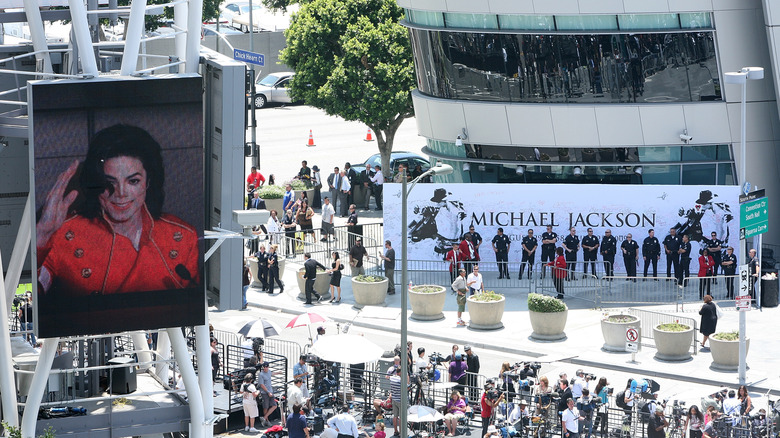
While some people are convinced that Michael Jackson is still alive, the King of Pop died in June 2009 at the age of 50 from a drug overdose. Twelve days later, the Michael Jackson Public Memorial Service, produced and promoted like a concert, took place at Staples Center in Los Angeles. Demand for seats was such that event organizer AEG held a ticket lottery. Of the 1.6 million who entered, only several thousand got the official pass: A glitter-covered hospital bracelet. Thousands of un-ticketed mourners filled the 10 blocks around Staples Center and were kept back by 14,000 police officers.
The service began with soul legend Smokey Robinson reading notes of regret from celebrities who couldn't attend. Technical difficulties resulted in an unplanned 10-minute break before a gospel choir heralded the arrival of Jackson's golden coffin. The amassed crowd remained silent for 15 minutes during that setup, and then a series of speakers took the microphone. The Reverend Al Sharpton implied that Jackson's popularity eradicated racism, Queen Latifah read an original poem by Maya Angelou, and Magic Johnson told a story about the time he ate Kentucky Fried Chicken with the singer. Each eulogizer received a hug from Jackson's brothers, each dressed like the King of Pop in his '80s look of sunglasses and a white glove. One of the final speakers was Jackson's 11-year-old daughter, Paris Jackson, who could only cry and talk about her love for her dad while a relative off mic could be heard pushing the distressed child to talk louder.
Ronald Reagan
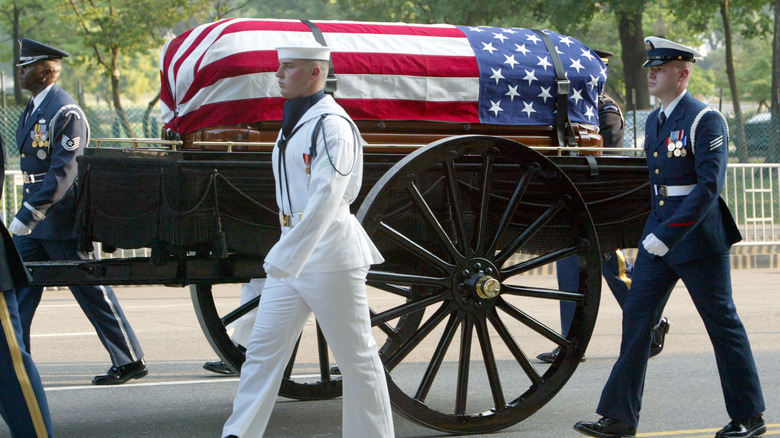
In the years after President Ronald Reagan left office in 1989, he developed a heavily detailed funeral plan that was annually reviewed by former first lady Nancy Reagan. When Reagan died in June 2004, the postmortem events followed a massive, unprecedented 300-page document, which combined state and military funeral customs, presidential funeral traditions, and his extensive wish list. Following his death, his body was taken to his presidential library in California for a day of public viewing. It was then transported by plane to Washington, D.C., to lie in state on Capitol Hill for two days.
In a dramatic moment couched in military symbolism, Reagan's body was led to the seat of the federal government in a procession headed by a single drummer. Then came the carriage, propelled by six horses, carrying the 700-pound mahogany casket with the deceased president inside. Behind that vehicle trotted a horse with no rider, carrying a pair of black boots wedged backwards in stirrups, representing a leader of the people struck down. After the two-day period ended, a motorcade took Reagan to the National Cathedral for a state funeral. On that declared national day of mourning, the federal government was shut down, as was the New York Stock Exchange.
Aretha Franklin
After Aretha Franklin tragically died in 2018, the Queen of Soul's home base of Detroit became the site of a days-long memorialization process that felt like the funeral of actual royalty rather than American musical royalty. The general public could pay their respects to the singer over a three-day viewing period at the Charles H. Wright Museum of African American History. How Franklin's body was dressed depended on the day of the visitation, as the outfit rotated between a series of three different ensembles: a crimson dress, a pale blue dress, and a rose-gold suit. When she was buried at Woodlawn Cemetery, it was in another outfit: A gold dress with shimmering high-heeled shoes.
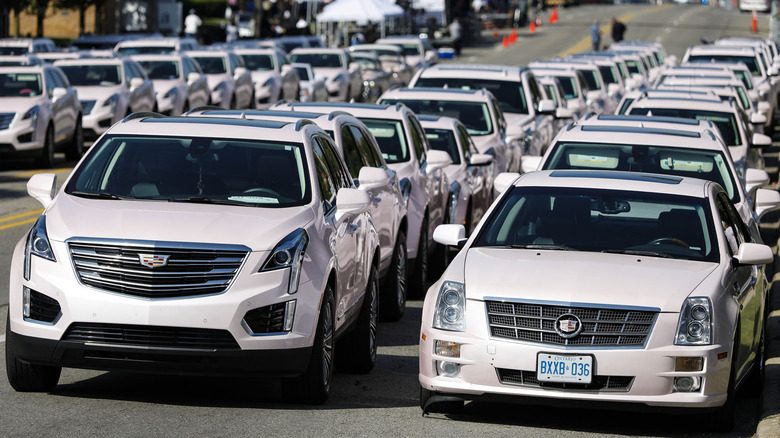
Franklin's funeral on August 31, 2018, was held at Greater Grace Temple, and the event lasted for just over eight hours. It was attended by luminaries such as former President Bill Clinton, and more than a dozen A-list singers performed Franklin's songs, hymns, and gospel numbers, including Gladys Knight, Chaka Khan, Ariana Grande, Stevie Wonder, and Faith Hill. And as a nod to a lyric in Franklin's 1985 hit "Freeway of Love," more than 100 pink-colored Cadillacs and other cars, some parked two or three deep, filled a city block as part of the funeral procession.
Genghis Khan
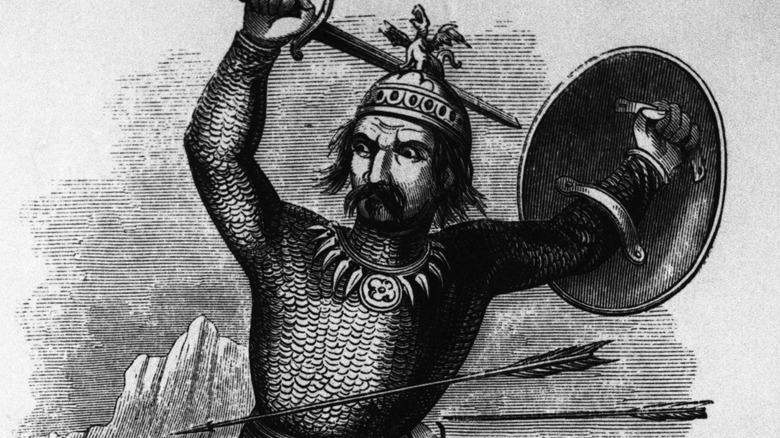
According to legend, lore, and secretive record keeping from 13th-century Mongolia, extreme measures were taken to ensure that the final burial place of warrior and conqueror Genghis Khan, who established and ruled the Mongol Empire, remained forever unknown. In his writings, European explorer of Asia Marco Polo wrote about Mongolian emperor funerals with regard to Genghis Khan's grandson, Mongou Khan. It was tradition, Polo wrote, for the emperor's associates to kill all of the military's strongest horses so that they may accompany their leader in the afterlife.
In addition to all that animal murder, innocent people were killed, too. Anyone who happened to see a funeral procession of an emperor — and thus be aware of the general vicinity of the burial — was summarily executed, a number that could stretch into the tens of thousands. Genghis Khan's tomb, when it was finally built underground, was obscured further by having 1,000 horses run over the ground to destroy any evidence of digging. Indeed, that tomb has never been discovered, despite multiple sophisticated modern operations devoted to finding it.
John F. Kennedy
Brutally shot and killed while riding in an open car in Dallas on November 22, 1963, JFK's assassination was a lot worse than people think. President John F. Kennedy was buried at Arlington National Cemetery in Virginia, near Washington, D.C., afforded the benefits and rituals for his past military service. On the day of the funeral, November 25, the president's body was transported to St. Matthew's Catholic Cathedral for a requiem Mass and then onto an official state funeral at Arlington.
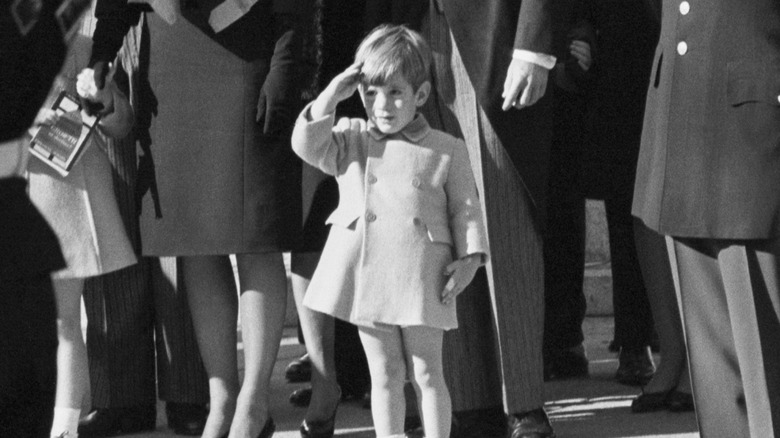
During the transit of Kennedy's coffin, a photographer captured one of the most emotionally affecting and famous images in American history. As the car with the body drove by, Kennedy's young son, John F. Kennedy Jr., stood by, held his hand up to his brow, and saluted his deceased father. "It was the saddest thing I've ever seen in my whole life," New York Daily News staff photographer Dan Farrell told his publication about the picture he took.
Some of the context surrounding that stirring and poignant image was underreported. Notably, John F. Kennedy Jr. stood with the presidents' brothers and his mother, Jacqueline Kennedy. It was the first lady who thought the salute would be a nice idea, and she asked young Kennedy to do so. Another sad detail: The day of his father's funeral fell on JFK Jr.'s third birthday.