

The Real Reason These Bands Broke Up
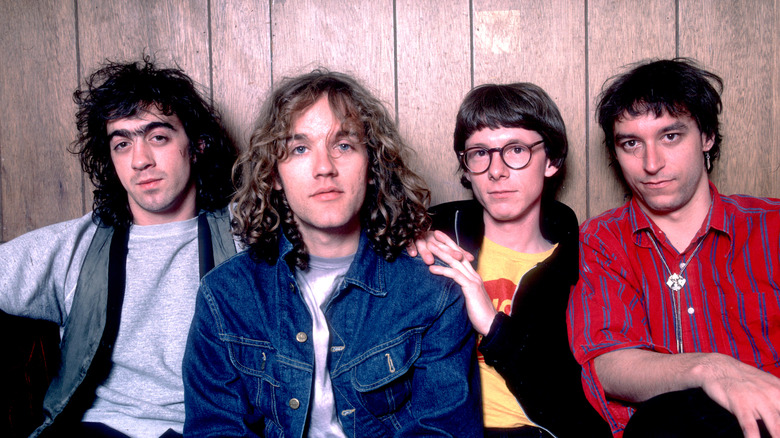
It takes a lot of time, hard work, artistic ability, and good old-fashioned luck for a band to jump from the garage to a sold-out stadium tour. But then, all too frequently, those bands of brothers and sisters walk away from the money and fame to split up the band and go their separate ways. There are lots of reasons why. Just to name a few, you have creative disagreements, personality clashes, the desire to make a terrible solo album, and Sting being Sting.
We cover a lot of bands here, from the iconic to a few that were less mainstream. And even though the bands didn't make it, the music they created together has lasted with fans all over still playing the albums and songs these groups produced when they were at their best. They gave us that, at least. After all, it's true that nothing lasts forever (except the Rolling Stones). Here are some bands whose reasons for their splits are as singular as their music.
Blondie
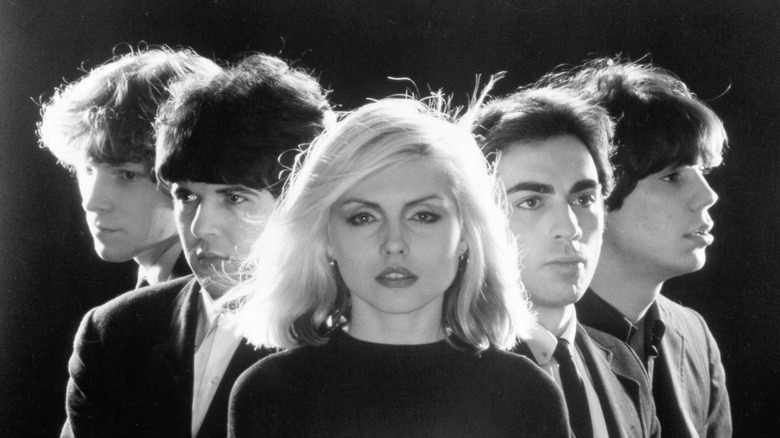
Disease isn't as common a cause for a band splitting up as the more stereotypical reasons, but a devastating, potentially fatal illness shut down Blondie in its prime, putting a premature end to the career of one of the most popular and versatile bands of the late '70s and early '80s. The chief creative team behind the band's success was lead singer Debbie Harry and guitarist Chris Stein, who together wrote Blondie's hits "Heart of Glass," "Dreaming," and "Rapture." They were also romantic partners when Blondie was huge. So much so that when Stein got sick, it consumed Harry's life, too.
Around the time of the band's official breakup, Stein was diagnosed with a rare disease called pemphigus vulgaris, which causes painful blistering on the skin, mouth, throat, and lungs. For several years, Stein was out of commission, and Harry stayed by his side. Stein and Harry split up in 1989, but reunited — professionally — when Blondie reformed in the late '90s.
The Clash
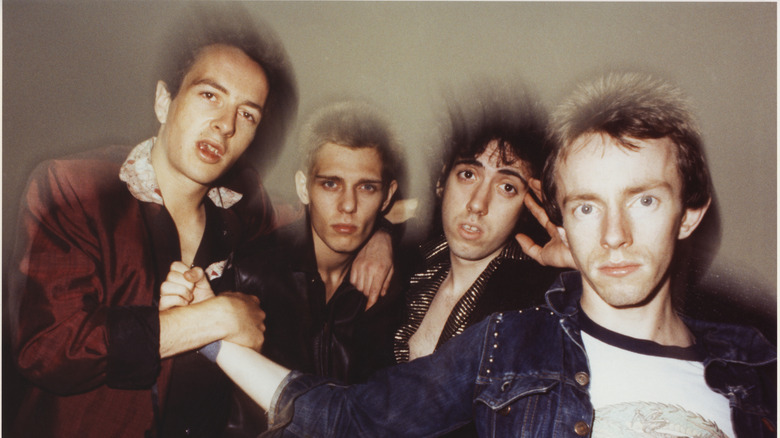
The Clash was such a politically insightful and incendiary punk band that it was christened (hilariously and ironically, by their big corporate record label) "the only band that matters," according to The New Yorker. But that kind of intensity just can't last, and The Clash sputtered out in 1986.
According to the 1999 book, "The Clash Talking: The Clash in Their Own Words," frontman Joe Strummer said that members had been "tired." He went to say, "there had been a lot of intense activity in five years. Secondly, I felt we'd run out of idea gasoline." Those are some pretty common and understandable break-up excuses, but Strummer gave another reason: The Clash didn't want to turn into their dads. (Or at least they didn't want to turn into the prior generation's rock 'n' roll dinosaurs.)
In 1982, The Clash opened for The Who on one of its many farewell tours. Seeing the once electrifying band play their greatest hits on the nostalgia circuit chilled Strummer. "We saw what The Who were like at the end of their tether. It's a bad scene. You quickly turn into nothing," per Loudersound.
Uncle Tupelo
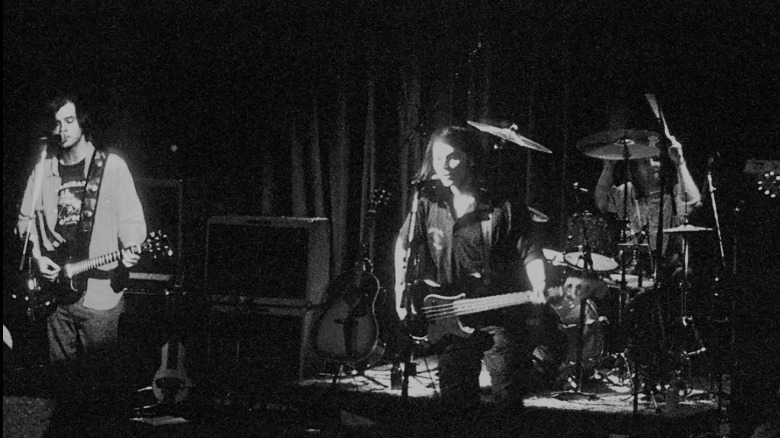
In the late '80s and early '90s, Illinois's own Uncle Tupelo was a pioneering band of the country-inflected, roots-rock "Americana" sound. (You know, that pleasant, inoffensive, jangly guitar music they play in the middle of the day on NPR.) While heavily influential, Uncle Tupelo's most prominent members, Jay Farrar and Jeff Tweedy, went on to bigger mainstream success with their subsequent bands, Son Volt and Wilco, respectively.
So what happened to Uncle Tupelo? Well, Tweedy slowly took creative control of the band, which Farrar didn't like. They stopped talking and drummer Mike Heidorn left, leading to the great schism that resulted in Son Volt and Wilco. But in a 2005 interview with Relix, Farrar suggested there was one more factor: the creep factor. Farrar's girlfriend (and future wife) was a woman named Monica Groth, and while she was sleeping one day, Tweedy stroked her hair ... and Farrar caught him. "I found out later that he was telling her stuff, like, he loves her," Farrar said (via ilxor).
Farrar immediately threatened to leave the band, which deeply upset Tweedy. He hung around for a while, only to quit for good and blow up Uncle Tupelo in 1994, confronting Tweedy when he felt that "the dynamic had changed and it wasn't fun for me anymore." In return, Farrar says, Tweedy called him a "p***y." But if that bit of salaciousness is true, Farrar downplayed it in 1996, when he told the Los Angeles Times, "To me. the band had just run its course. After six or seven years of doing the same thing, you start to question what you're doing."
Queensrÿche
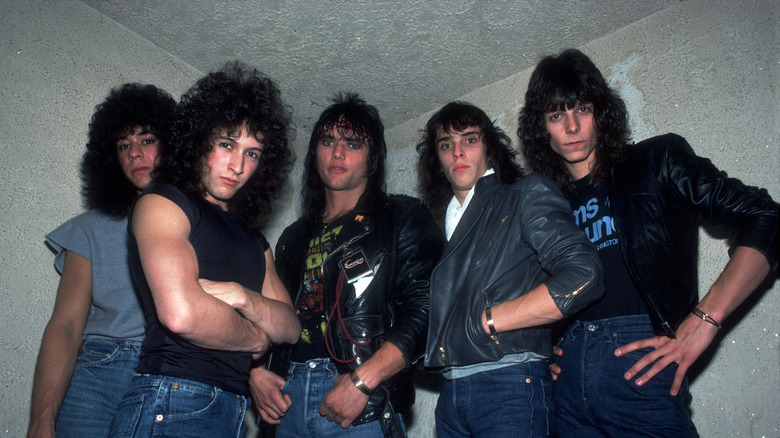
"We've all known each other for 30 years," longtime Queensrÿche singer Geoff Tate told Rolling Stone. "For it to end in such a hostile way, it's just mind boggling." Tate said the trouble started in early 2012, when Tate and the band's management objected to the rest of the band's decision to turn over its merchandise management to an outside company. That summer, Tate was kicked out of the band because of, according to a press release, "creative differences." Maybe not so much.
"To have creative differences," Tate quipped to Rolling Stone, "you have to have two entities or more offering up creative ideas. And that just wasn't the case. Queensrÿche has always been my idea." The proverbial straw that broke the prog-rock camel's back: a pre-show altercation. While backstage at a gig in Brazil, Tate confronted the band about rumors that he was about to get replaced — as various members of management and the road crew had just been fired, all of whom were Tate's relatives. The rest of Queensrÿche scoffed at the idea, but just before the band hit the stage, Tate says drummer Scott Rockenfield said, "We just fired your whole family and you're next." That's when Tate let his fists do the talking ... sort of. "I tried to punch him. I don't think I landed a punch before somebody grabbed me and hauled me to the side." The show went on as planned, but that was it for that version of Queensrÿche.
The Zombies
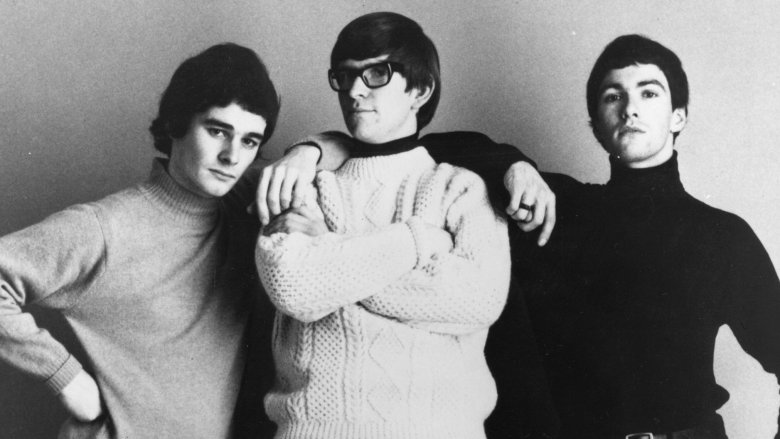
The Zombies' 1968 album "Odessey and Oracle" is stylish, beautiful, and haunting, and tracks like "Time of the Season" frequently pop up in movies to let the audience instantly know, "Hey, this is set in the '60s, man!" At the time of its release, however, the album was a flop. Keyboardist Rod Argent told Express that the band's income further cratered because "our fees for playing live had gone down a lot, and we had no money." The Zombies split because they couldn't afford to stay together ... or so they thought.
"We later found out after we'd broken up that we had hits at some place in the world at almost any time. It was just in the U.K., we had less success than anywhere else!" Argent explained. More than a year later, Argent says a promoter offered the band $1 million to reunite and tour the United States, one of the many places where songs from "Odyssey and Oracle" had become huge hits. "But by that time," Argent says, "we'd advanced strongly on different paths."
The Everly Brothers
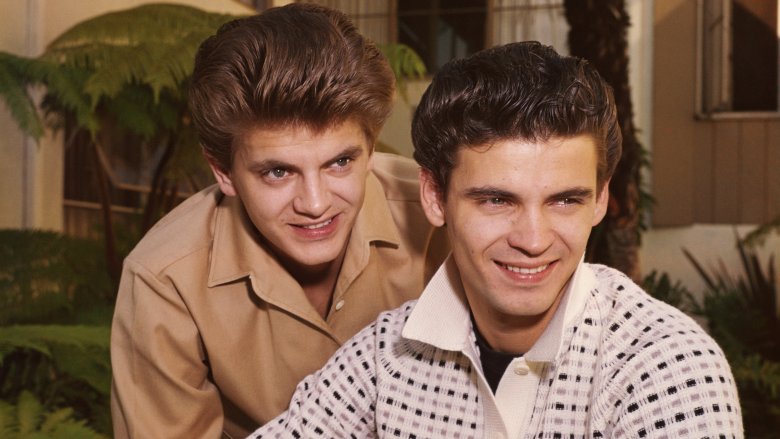
What's the one relationship more intense than that between two siblings? Being in a band together. The Everly Brothers — Don and Phil — were really brothers, were really successful musicians (they had hits in the '50s and '60s like "All I Have to Do is Dream," "Cathy's Clown," and "Bye Bye Love"), and fought and bickered like both. And like many families, they had a horrible, life-changing experience at Knott's Berry Farm.
Don Everly informed Phil Everly that their July 1973 show at the Los Angeles-area amusement park would be their last as a duo, for he was "tired of being an Everly Brother." Then Don showed up so drunk that a park manager tried to stop the show. That got Phil so mad that he left the stage, smashing his guitar on the way. Don, somehow, finished the show by himself. According to CBS News, Don told the bewildered crowd, "The Everly Brothers died 10 years ago." But the group really died right there and then.
They did reunite on occasion, however. They played a single show at Royal Albert Hall in London in 1983, and in 2003, Paul Simon recruited the Everly Brothers to tour with Simon and Garfunkel. "Don and Phil hadn't seen each other in about three years," Simon told Rolling Stone. "They met in the parking lot before the first gig."
Jane's Addiction
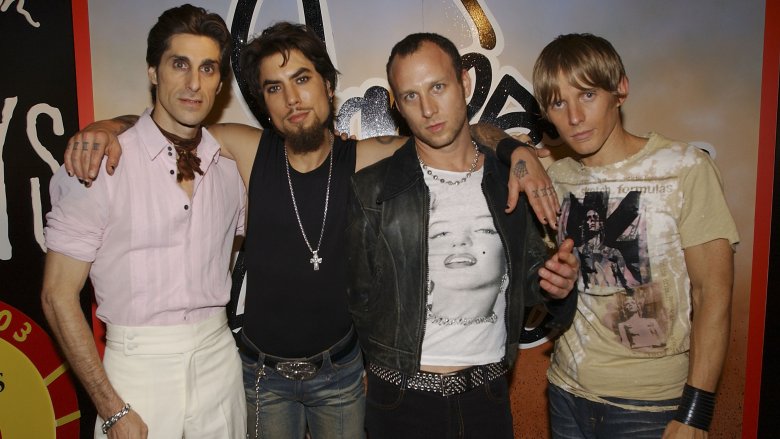
Jane's Addiction was one of the first "alternative rock" bands, pioneering the form in which Nirvana and Smashing Pumpkins would become superstars. They have also broken up and re-banded several times. The first came when recording their 1990 breakthrough hit "Ritual de lo Habitual" was so tension-fraught that the band agreed to hit the road for the first Lollapalooza tour in 1991 (organized by Jane's Addiction singer Perry Farrell) and then break up. That was probably for the best: Jane's Addiction's set on the first Lollapalooza ended early because Farrell and guitarist Dave Navarro got into a fight in front of thousands of fans.
Another major contributor to the group's demise: differing viewpoints about the rock 'n' roll lifestyle. When Dean Kuipers of cool music bible Spin profiled the band in 1991, he presented a group split into two camps: Farrell and drummer Stephen Perkins were down to party and party hard; Navarro and bassist Eric Avery had kicked heroin and were desperate to stay clean. The band's bus even had a special drug-free "safe space" where Navarro and Avery could hang out and just ... not do drugs. By 1992, Jane's Addiction was done, although, like most successful bands that split, they've reunited a few times for tours — something they continued to do for nearly three decades.
The latest break up, though, came in September 2024 when Farrell started an altercation with Navarro on stage in Boston during their latest reunion tour. Navarro and the other members of the band, Stephen Perkins and Eric Avery, posted on Instagram that they were canceling the remainder of the tour, then in July of 2025, the three men filed a lawsuit against Perry claiming: "The Band can no longer function as a result of the Defendant's conduct, including his sudden, violent outbursts and demonstrated inability to serve as the Band's frontman and vocalist ... it is time for Defendant to face the consequences of his actions and be held accountable" (via Rolling Stone). Only time will tell if the volatile rockers will ever reunite again. Stranger things have happened.
Adam and the Ants
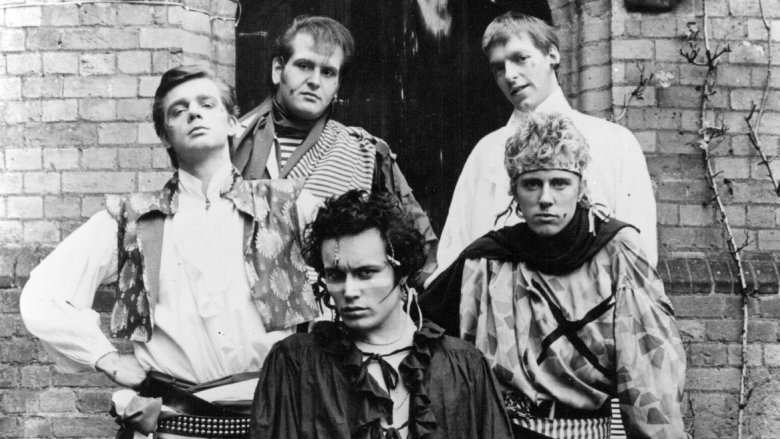
There have been lots of bands where the look was as important as the sound. A Flock of Seagulls and their bizarre haircuts, for example, or Adam and the Ants dressing like pirates for some reason. But for the first iteration of Adam Ant's punky/New Wave band, the substance matched the style — the band's debut record "Dirk Wears White Sox" sold well, and besides, they had to be good if somebody tried to poach most of the musicians.
Sex Pistols manager and controversy hound Malcolm McLaren also handled Adam and the Ants, but when he quit in 1980, he convinced everyone in Adam and the Ants who wasn't named Adam — Leigh Gorman, Dave Barbarossa, and Matthew Ashman — to join him. McLaren used them to create a new band called Bow Wow Wow. McLaren, forever believing the maxim that there's no such thing as bad press, installed a scantily-clad teenager named Annabella Lwin as the group's singer. That group is best known today for its cover of the '60s pop song "I Want Candy," while Ant found some more guys with cool pirate shirts to be his new Ants.
The Smiths
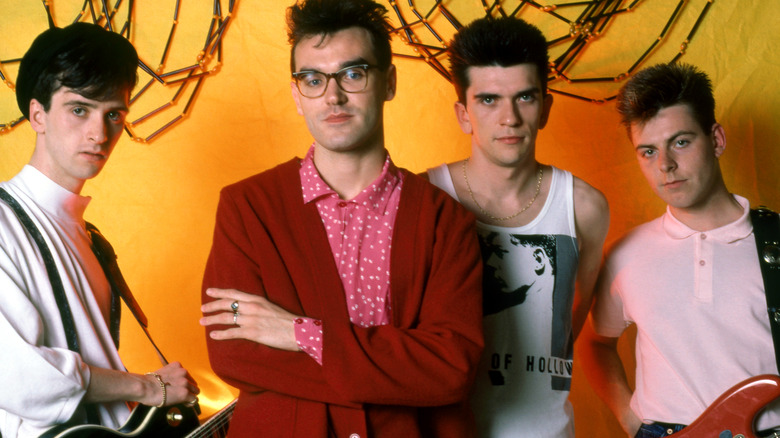
Hey, guess what, the dude who wrote "Girlfriend in a Coma" was kind of quirky. Bet you didn't see that one coming. Morrissey's quirkiness helped The Smiths become a staple of the 1980s — without him, the Smiths might have just been an ordinary pop group singing about inane stuff like young love and getting dumped, but why settle for standard heartache when you can go the extra mile and put the object of your affection in a danged coma instead.
There is such a thing as too quirky, though, and Morrissey might have maxed out his quirkiness when he decided that the thing missing from the Smiths' musical offerings was more 1960s cover songs. When the band released the single for "Girlfriend in a Coma," the B-side featured the band's cover of the 1968 Cilla Black song, "Work is a Four Letter Word." "I hated it," guitarist Johnny Marr told Record Collector magazine in 1992 (via Mancunian Matters). "That was the last straw, really. I didn't form a group to perform Cilla Black songs. I made a decision that I was going to get away on holiday. The only place I could think of where I knew there'd be sunshine was LA, so off I went. I never saw Morrissey again."
Guns N' Roses
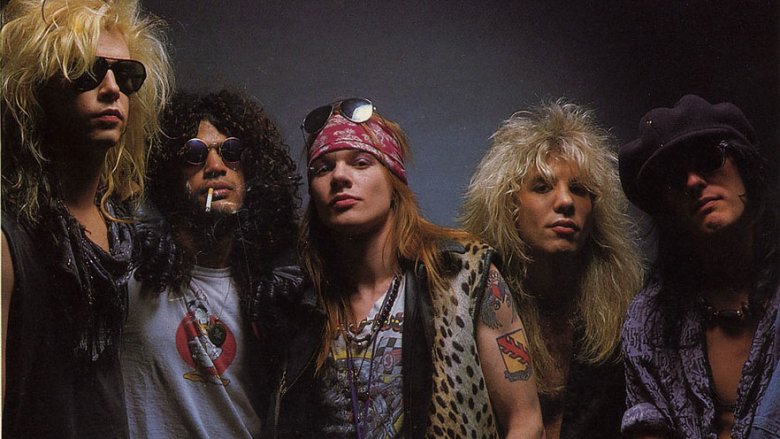
Guns N' Roses was already burning out when asked to cover cover the Rolling Stones song "Sympathy for the Devil" for the 1994 film "Interview with the Vampire." According to Rolling Stone, Axl Rose and Slash weren't really talking to each other at that point, so when they screened the movie, they did it separately, and arrived at separate decisions about producing a song for the soundtrack. Slash hated the movie and didn't want to record the song; Axl loved it and wanted to get started right away. Slash ended up relenting because he thought there might be a silver lining — if the song got everyone together in the studio, then that was a good thing.
He was being too optimistic, though. Axl was never in the studio when everyone else was, yet he still wanted to micromanage Slash's guitar solo. And then Axl decided to add more identical guitar right over the top of the guitar Slash had already played, which was both baffling and insulting.
Slash stuck around for another couple years but has always cited that cover track as the reason for the band's demise. "If you've ever wondered what the sound of a band breaking up sounds like," he wrote, "listen to Guns N' Roses' cover of 'Sympathy for the Devil.' If there is one Guns track I'd like to never hear again, it's that one."
Rage Against the Machine
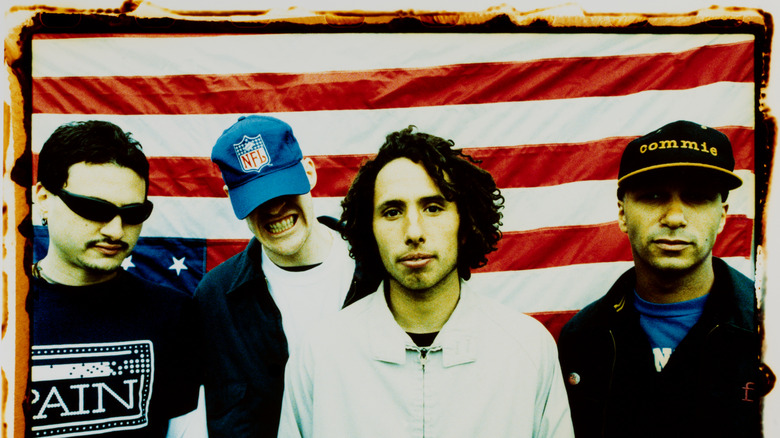
Limp Bizkit has always cited Rage Against the Machine as one of their major musical influences, and Rage Against the Machine, meanwhile, has talked about feeling "really bad that we inspired such bull****," according to Rolling Stone. But as it turns out, even the older kids can sometimes be prone to childish behavior. When Limp Bizkit's "Break Stuff" beat Rage Against the Machine's "Sleep Now in the Fire" for "Best Rock Video" at the 2000 MTV Video Music Awards, Rage's bassist Tim Commerford interrupted the acceptance speech by climbing to the top of a 20-foot fake palm tree and then, much like a pouty child, refusing to come down.
Commerford was arrested for disorderly conduct, but he never really seemed to think it was more than an act of "personal politics." Bandmate Zack de la Rocha, though, told the press that the incident had left him feeling "humiliated," according to the book "Know Your Enemy: The Story of Rage Against the Machine." The band broke up for the first time not long afterward, and that particular incident is often cited as one of the driving forces behind the split.
However, the group reunited twice and split again in 2011 and in 2024. In the last breakup, frontman Zack de la Rocha injured his Achilles tendon while on tour in 2022, which forced him to stay seated while performing. After doing that for a while, they canceled the rest of the tour. In January 2024, drummer Brad Wilk posted on Instagram that "RATM (Tim, Zack, Tom and I) will not be touring or playing again live." He said he didn't want to "string people or myself along" and apologized to fans.
Cream
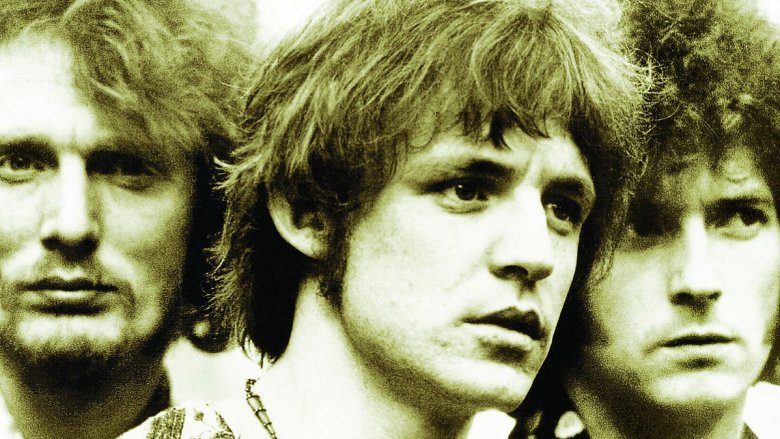
Ego is a tough problem for musicians. It must be pretty hard to stay humble when you sell 15 million records in three years, your concert tickets have an almost supernatural ability to sell themselves out, and your audiences are always full of screaming members of your preferred gender. By the time you get to that point, you almost certainly think of yourself as some kind of rock god, and what do you do if you're a rock god except trash hotel rooms and use your groupies? Well, you also play and sing loudly because everyone knows that gods have big, booming voices, right?
Cream's stack of amps grew exponentially as their popularity did, until Eric Clapton and Jack Bruce each had a triple stack of Marshalls. "By 1968, I was just the poor bastard stuck in the middle of three incredible noise-making things," drummer Ginger Baker told Guitar World. "It was ridiculous. ... The incredible volume was one of the things that destroyed the band. Playing loud had nothing to do with music. There was, in fact, one gig where Eric and I stopped playing for two choruses. Jack didn't even know. Standing in front of his triple stack of Marshalls, he was making so much noise he couldn't tell."
There were other factors, too — Baker and Bruce were constantly at odds and were ultimately unable to resolve their differences. The band split up after just three years.
The Libertines
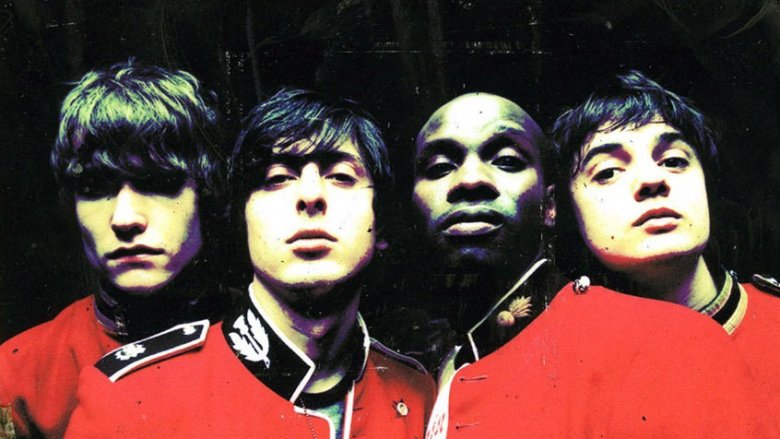
Libertines frontman Pete Doherty had a £200-a-day drug habit when bandmate Carl Barat finally said, "Don't come and play with us till you sort yourself out," per The Guardian. After that, Doherty did what anyone would do — he quit cold turkey, turned his life around, and was invited back to the Libertines with open arms. Just kidding. While the rest of the band was on tour in Japan in 2003, he kicked in Barat's apartment door back home. According to the Guardian, Doherty made off with an antique guitar, a video recorder, a CD player, and a laptop, among other things. He spent two months in prison for the crime, but jail didn't seem to fix any of his problems.
Weirdly, the rest of the band seemed to forgive him, and they even played a show the day of his release, but the good feelings didn't last long. Doherty was asked to get clean again, but instead of working on that, he decided to just form another band with some guys who didn't care whether he was a drug addict. The Libertines officially broke up in 2004.
The Beatles
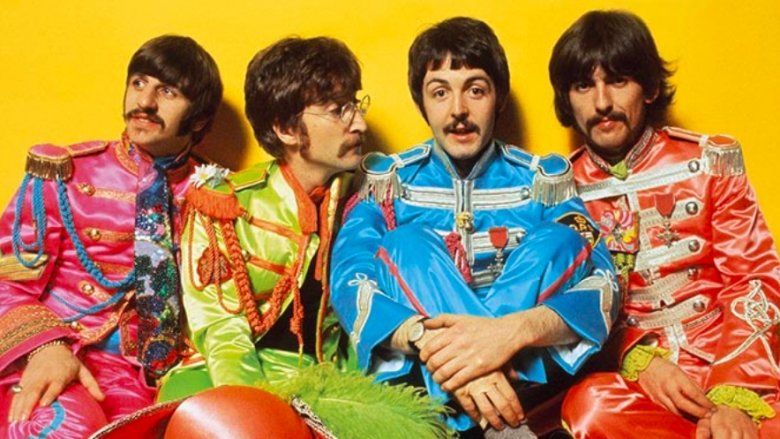
Everyone blames Yoko Ono for the demise of the Beatles, but it wasn't just her constant presence wherever John Lennon went, including the recording studio, that broke up the band. In fact, by 1970, the Beatles had a whole mess of problems — financial, legal, and personal. While many feel the need to blame one thing, it was more of a culmination of a decade of interpersonal relationships evolving, all while being cast into the stratosphere as world famous musicians. What's more, the fab four, who were teens when they met and in their early 20s when they became so popular they couldn't hear themselves playing their own concerts over the sound of screaming fans, were growing in different directions.
As drummer Ringo Starr said in a 2008 interview (via YouTube), "It was a bit of a drag it broke up even though we all wanted it. We had been working steady for eight years and we'd been these brothers, and certainly, like, that was over. ... We'd all grown up a little more, and we weren't prepared to put in the time and energy for each other." He added that even though they understood the band was not going to continue while recording their final album, "Let It Be," when it was time to record, "We all gave our best ... the music was always important."
R.E.M.
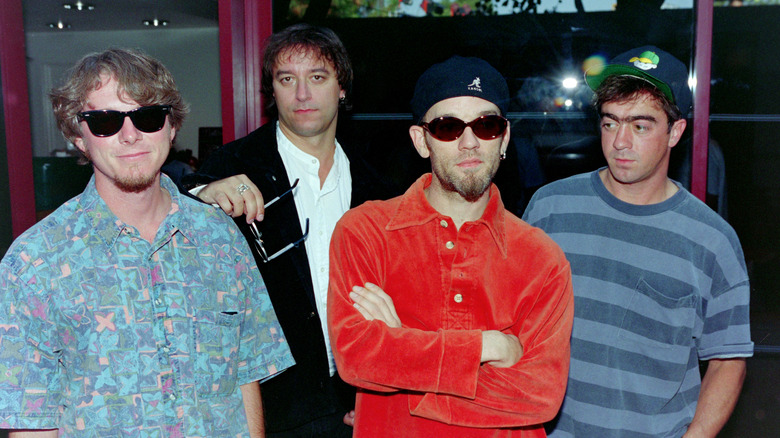
Some would say that the secret to R.E.M.'s longevity and success was the fact that the alternative rock band's membership stayed as consistent as it did for the longest period. From 1980 to 1997, the core remained Michael Stipe, Mike Mills, Peter Buck, and Bill Berry. Berry, the band's drummer, left in 1997 following a brain aneurysm, saying, "I'm at a point in my life where my priorities have shifted. I loved my 17 years with R.E.M., but I'm ready to ... move on to a different phase of my life," per Rolling Stone. The group continued with a rotating cast of percussionists until 2011 before announcing they were calling it quits after 31 years. For fans, it was the end of the world as they knew it — and they didn't feel fine.
So, what was the real reason R.E.M. broke up? As Mills told Rolling Stone, the band had floated the idea around since 2008, but they still had contractual obligations to fulfill. Ultimately, though, they knew it was time to sail off into the sunset when they did. "It's not because we have to or we can't stand each other or we suck," Mills said. "We're happy. But we're done."
Stipe summarized it succinctly in the initial breakup statement: "A wise man once said, 'The skill in attending a party is knowing when it's time to leave.' We built something extraordinary together ... Now we're going to walk away from it." Since then, R.E.M. has reunited on stage for rare performances, but they maintain that a full-blown reunion is out of the question.
White Zombie
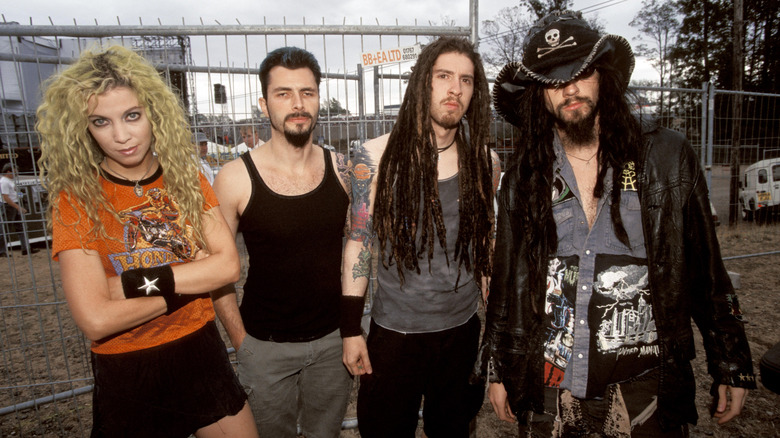
White Zombie's distinct groove-based brand of industrial metal knew how to get moshers thrashing and dancing in equal measure. From "Thunder Kiss '65" to "More Human Than Human," the band's biggest hits still receive regular rotation at heavy metal clubs. While they officially formed in 1985, it took a while for them to break out into the mainstream in the '90s. In 1998, though, the news broke that the party was over for White Zombie, as vocalist Rob Zombie went solo and brought along drummer John Tempesta for the "Hellbilly" ride.
According to Zombie's comments to MTV News, the breakup had been on the cards. "This thing had been dragging on forever," he said. "I was thinking about it that morning and I called up [White Zombie guitarist Jay Yuenger] and said we needed to get everyone on the phone and talk it over and figure out what's going on."
White Zombie bassist Sean Yseult, who had dated Zombie, stated the band had been on a hiatus for a year. While she wasn't surprised about the breakup, she said that both she and Yuenger were blindsided by Zombie's solo venture. "But the slap in the face was that his solo record came out like the next day," Yseult told "One On One With Mitch Lafon." "So, he had spent that year making a record, knowing that [we weren't] gonna be a band again. That was a little, you know ... But whatever."
The Police
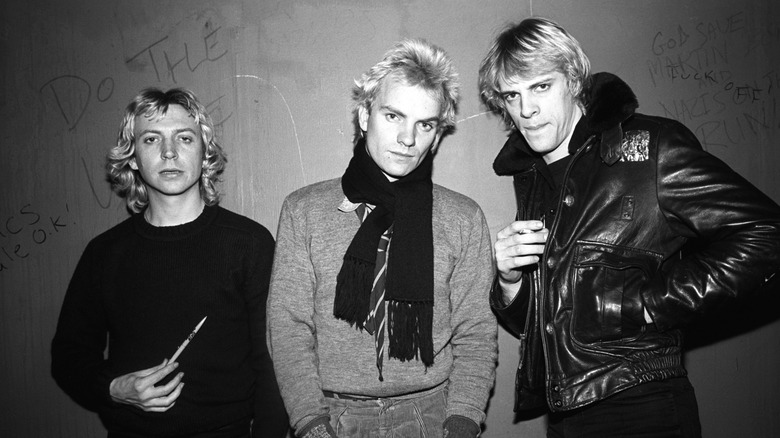
Mention the Police, and everyone thinks of frontman Sting. Yet, it was the combination of Sting (born Gordon Sumner), Stewart Copeland, and Andy Summers that made aural magic. As far as seminal bands go, the Police didn't have the longest run, starting in 1977 and going on a hiatus in 1984.
By 1986, though, the trio played a literal and figurative passing-of-the-baton show, where they handed over their instruments to U2. Even U2 singer Bono could see that this symbolic gesture held two meanings: U2 had been anointed as their successors and the Police was done. The Police tried to get together for one more album in 1986, but Copeland broke his collarbone before recording commenced, and Sting's heart wasn't in it anymore.
So, what was the real reason the Police broke up? It's fairly obvious to every fan of the band: Sting. The Police went on hiatus because Sting's solo career started to take off, and it never stopped after that. Yet, there had always been friction and tension in the Police, mostly because of Sting's dominant personality. "A band is a democracy," Sting told Rolling Stone. "Or the semblance of democracy. You have to pretend more in a band." By the end of the Police in the '80s, it wasn't a democracy at all, as Sting confirmed. The Police regrouped for a famous world tour in 2007, but it's highly unlikely they'll ever be a full-time band again.
Sonic Youth
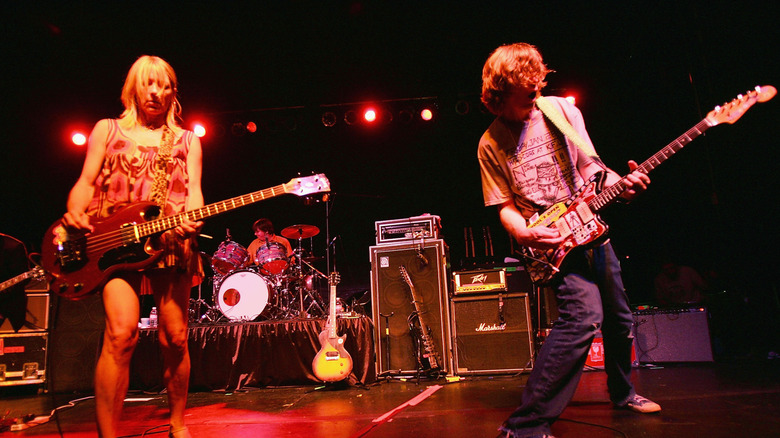
Sonic Youth don't often receive the plaudits they deserve. The rock band broke out in a time when synth ruled the airwaves and grunge loomed on the horizon. Yet, they stuck to their guns, playing music the way they wanted, on their terms, from 1981 to 2011 and becoming a firm favorite of modern-day indie groups. The three constant members from beginning to end were Kim Gordon, Thurston Moore, and Lee Ranaldo.
Gordon and Moore dated before starting Sonic Youth. In 1984, the pair married and became renowned as one of rock's most iconic couples. So, imagine the double whammy of confusion when the news hit that Gordon and Moore were separating after 27 years of marriage in 2011 — and with that came the end of Sonic Youth.
According to Gordon's comments to Elle, Moore started an affair with a woman named Eva Prinz, whom he worked with on another project. After Gordon discovered text messages between Moore and Prinz, they tried to work through their issues, but Gordon claimed Moore never stopped seeing Prinz. "We never got to the point where we could just get rid of her so I could decide what I wanted to do," Gordon said. "Thurston was carrying on this whole double life with her. He was really like a lost soul."
Talking Heads
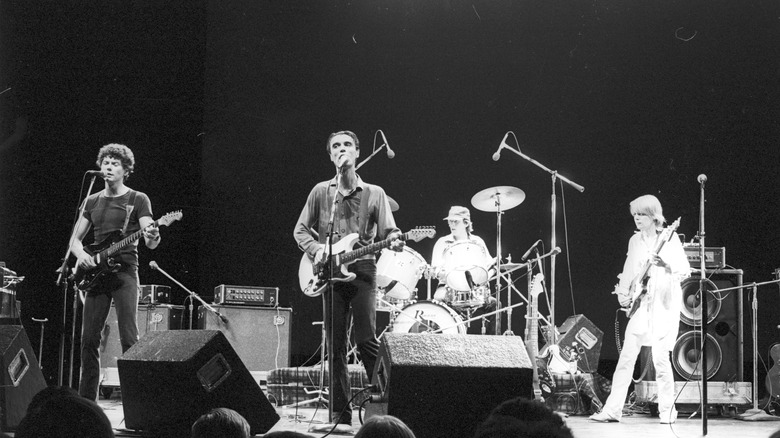
The new wave outfit Talking Heads continues to be spoken about to this day, thanks to their insatiable and always infectious 1977 hit "Psycho Killer," which seems to appear regularly in film and TV nowadays. The band formed in 1975 and were together until 1991 when singer David Byrne announced that Talking Heads was done during an interview. As it turns out, the other band members found out about the breakup at the same time as the rest of the world. They'd been on a three-year hiatus, and embarked on their own projects, but the news still came as a seismic shock to the members of Talking Heads. Was the band over, or did Byrne just decide to leave in his own unique way? No one quite knew.
According to the Los Angeles Times, the band members claimed that Byrne wasn't the best communicator and probably wanted to leave to pursue his own solo career, so this was how he handled it. They would play again at their 2002 Rock & Roll Hall of Fame induction ceremony, though.
For his part, Byrne apologized for how he handled the "ugly" breakup in 2023. "I have regrets on how that was handled," he told People. "I don't think I did it in the best way, but I think it was kind of inevitable that it would happen anyway. We have a cordial relationship now. We're sort of in touch, but we don't hang out together."
Sum 41
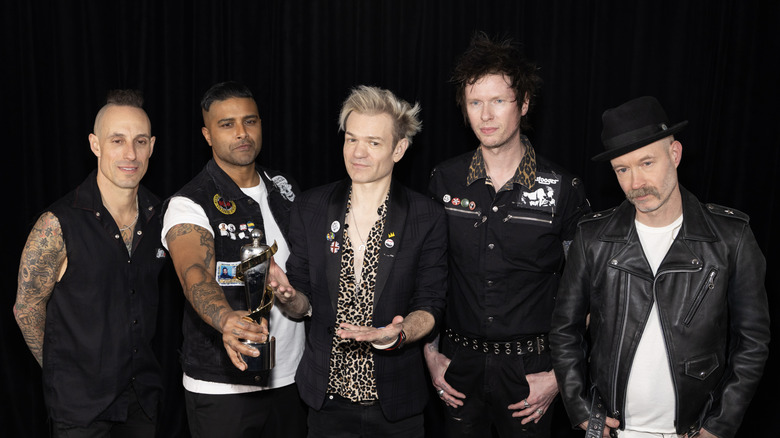
The early 2000s erupted with a plethora of pop punk bands — from Blink-182 to Good Charlotte. Sum 41 factored in this mix too, but they always appeared to be willing to play with their sound more than some of their peers, bridging the gap between heavy metal and straight-up punk to leave everyone else with a fat lip. They remained consistent as well, releasing a stream of albums and playing regularly from 1996 to 2025. However, in 2023, the band announced on their Instagram account that after their next album, "Heaven :x: Hell," and subsequent tour, the sum of 41 would be zero. It was over.
Speaking to the Canadian Press in 2025, Sum 41 opened up more about their decision to call it quits. Bassist Jason McCaslin and guitarist Dave Baksh explained how they were stunned to receive an email from vocalist/guitarist Deryck Whibley, who indicated he wanted to break up the band in 2023. They described how it was an email from the heart, as Whibley described his specific reasons for coming to this decision.
As Whibley explained, he was approaching burnout in the years prior and believed the band was about to peak with "Heaven :x: Hell," so he didn't think there was anywhere to go thereafter — plus, he wanted to do something else. "I'm not as excited about it as I once was," Whibley said. "And I don't want to do it just because it's a great paycheck."
NOFX
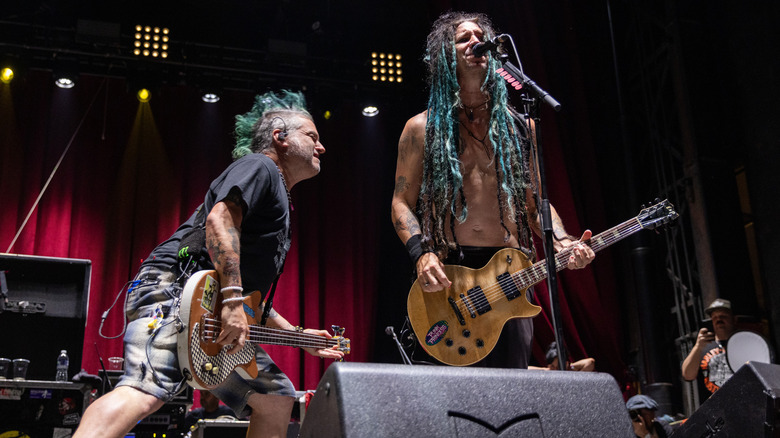
Punk rockers NOFX embodied the spirit of doing it on your own terms. Beginning in 1983, the group toiled away at making a name for themselves. After exploding in popularity, the major labels came knocking for their signature. Instead, NOFX signed with the punk-friendly Epitaph Records — founded by Bad Religion guitarist Brett Gurewitz. After some time with Epitah, NOFX decided to release their music under their vocalist Mike Berkett, aka Fat Mike's, indie label Fat Wreck Chords.
They remained a regular and revered ensemble in the alternative music community, but after celebrating 40 years as a band, they decided it was time to head off to the big punk rock graveyard in the sky. In October 2024, NOFX played their last-ever show in their home state of California.
Burkett told Westword in 2024, "Before a show, I don't want to play it, and I've had that feeling for years. Then I get loaded and I go on stage on booze or drugs or booze and drugs, then I have a good time. ... I really feel that that's what is one of the things that's special about NOFX is, I'm having a great time, and I think that shows. But I don't want to live like that anymore," he said. "When I made the decision, it was I'm just tired of doing this over and over again when I don't want to."